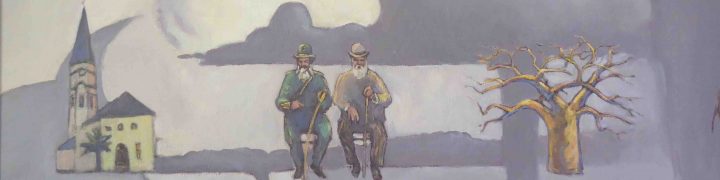
By the mid 1700’s, European landscape painting had fixed pictorial conventions. The aspirant painter would find an appropriate setting, preferably a vista framed by tall trees in the foreground, and get to work. Art critic Robert Hughes has shown how early Australian artists struggled to adapt this scheme to their new world, creating an idealised landscape instead.
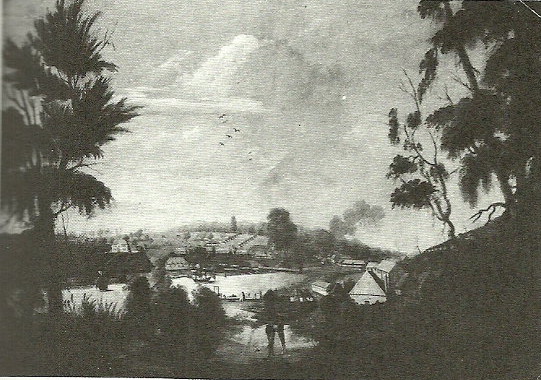
Thomas Watling: A direct north general view of Sydney Cove (1794)
In the Cape, Table Mountain and the lush greens of the surrounding forests were certainly “expressive of that peculiar kind of beauty, which is agreeable in a picture” (W Gilpin, 1792). But as explorers moved inland, they had no aesthetic language for the endless ochre expanse of the Karoo.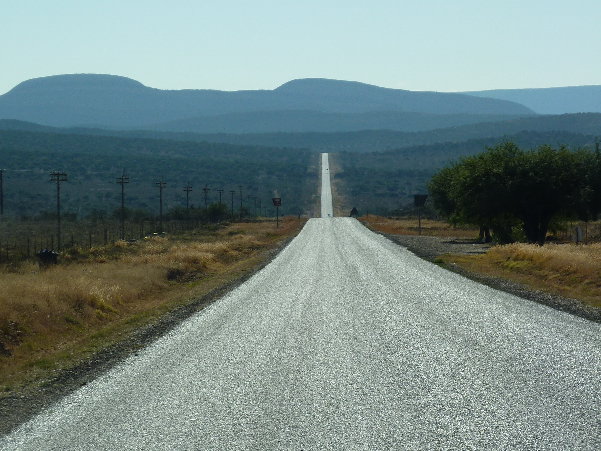 (They also didn’t have a tar road stretching before them.)
Alongside these notions of the picturesque, there was also the idea of the Sublime. British philosopher Edmund Burke’s “Enquiry into the Origin of our ideas of the Sublime and Beautiful” (1757) hugely influenced C18th English aesthetic thinking. Burke tried to understand the urge to experience the untamed and awe inspiring aspects of nature, qualities that were sought by the future generation of Romantic painters and poets. According to him, “dark, confused, uncertain images have a greater power on the fancy to form the grander passions than those which are more clear and determinate.” Poor old boy, he never went to the Karoo and felt his soul expand.
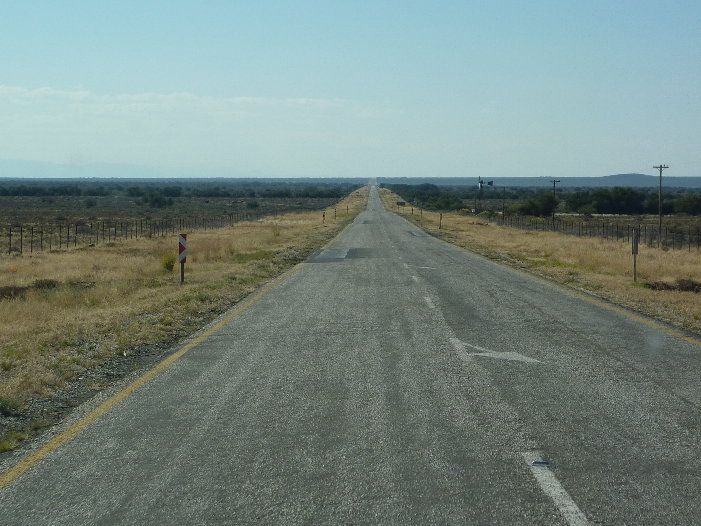
flat as sublime

 Travels with Pierneef
2 comments
Comments feed for this article
31/07/2010 at 15:06
Ant Strack
The land is forever in those spaces, the history in its expanse. I went exploring the concentration camps around the Gariep/Hendrik Verwoed dam last year in may. The landscape swallows you whole, the history from the turn of the century (1898-1902 2nd Boer war) and onwards is so close to the land you can feel it in the dirt.
03/08/2010 at 21:14
Carl Becker
Frightening to think what it must have been like in a camp on those vlaktes in winter. Summer too, come to think of it. True what you say about sensing it in the dirt.