You are currently browsing the tag archive for the ‘Simon Stone’ tag.
People often ask me what kind of work I do as a painter. I usually just say I’m a landscape painter. Everyone has some notion of what that is, and indeed I do paint landscapes. But I also paint things that are renderings of ideas, and these two things, being a painter of the thing seen, and being a painter of the thing imagined, are two poles of my artistic life. I veer between them. I spent the first half of the year working out various “idea” paintings – and now I need to have a good look at the great outdoors again.
I’m at the water’s edge, and huge winter clouds hang moodily over Walker Bay. It’s late afternoon and the light is beautiful. As the sun goes lower, all sorts of pink and yellow hues will permeate sky and ocean, presenting immense and daunting possibilities for the humble painter.
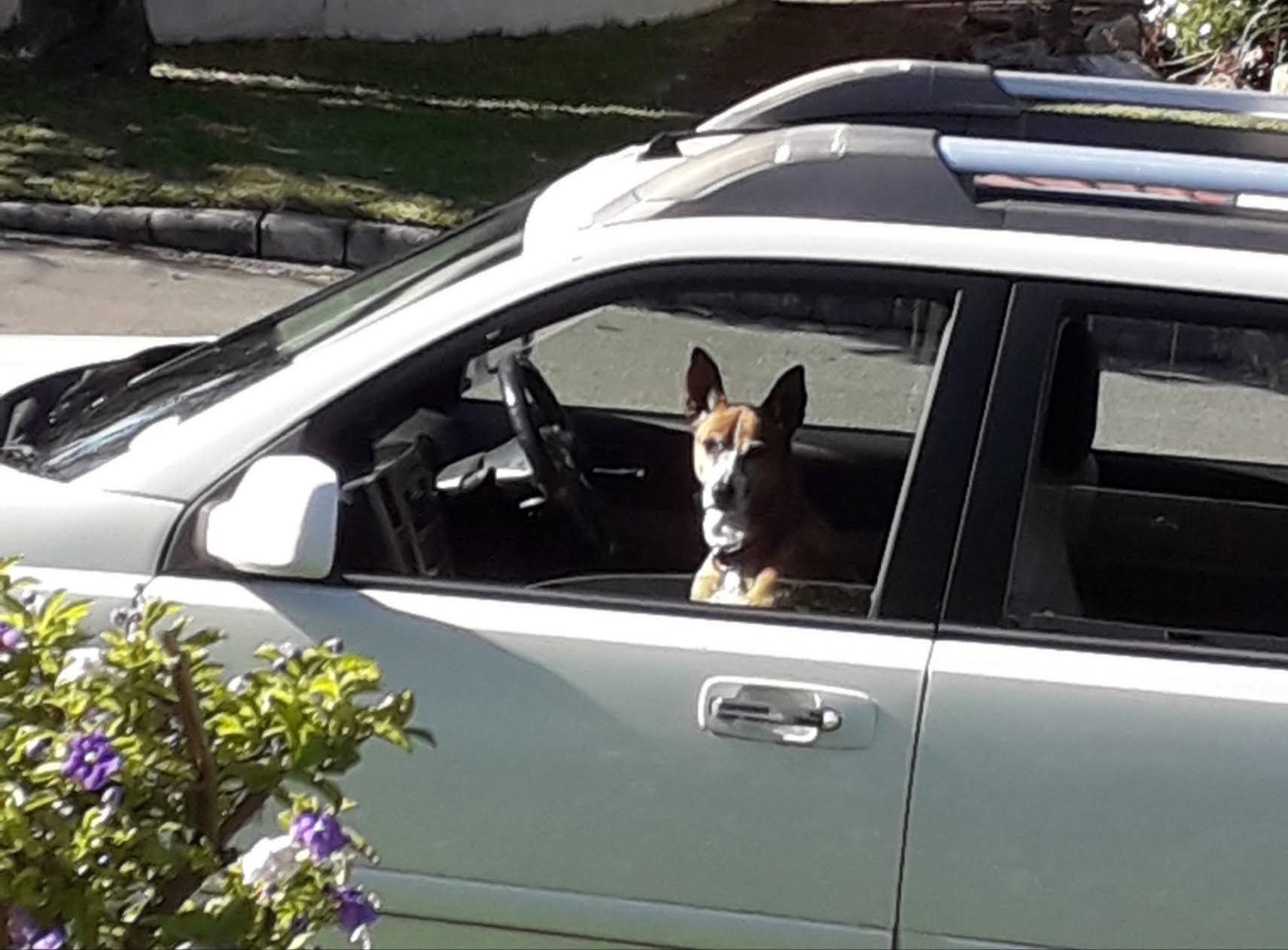
I’ve been looking at stuff in Hermanus for well over a decade. I go most evenings and do a quick drawing or a watercolour, the trusty Africanis hound by my side. We have our favourite spots on the beach or along the cliff path.
These are sketchbooky things, and truth be told, we are nothing like Mr Monet, who laboured incessantly in the wind and rain, “clad like the men of the coast, covered in sweaters, boots, and wrapped in a hooded slicker, his easel tied down with ropes and stones.”
No, we often just park out in the cosy cabin of my 2006 Nissan X Trail. I can see plenty of stuff from there, thank you very much.
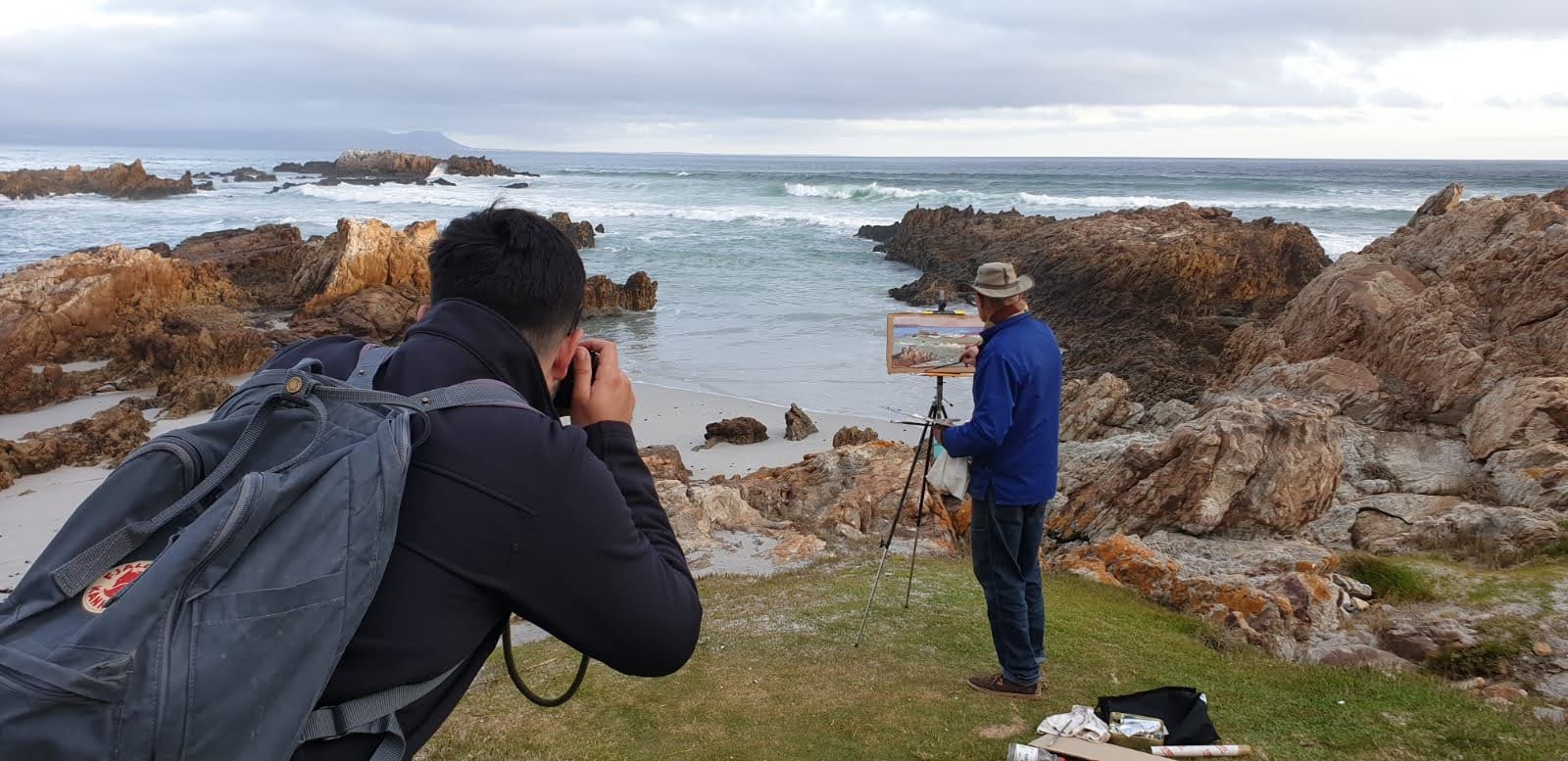
But today I’m outside, on the fabulous Cliff Path, and I’m using oil paints, pretending to be a plein – air painter. (“en Plein air “- the French term denoting working outdoors. It just sounds arty .)
I set myself up and without too much scratching of the head, I get going. I have a piece of cardboard to paint on. That’s my way of overcoming the fear of the pristine canvas. Cardboard is actually a great surface to work on – ask Simon Stone. I meet a photographer called Leanne Stander and next thing she ‘s photographing the artist at work. Then a wandering Spanish bloke also has to take a pic. Why? Did he think he was seeing a great artist at work? Or did he perhaps think he had come across something rather quaint and antiquated, like a model T Ford ? Suddenly my quiet little Sunday afternoon oil-painting experiment is becoming a performance. Help! I’m under scrutiny!
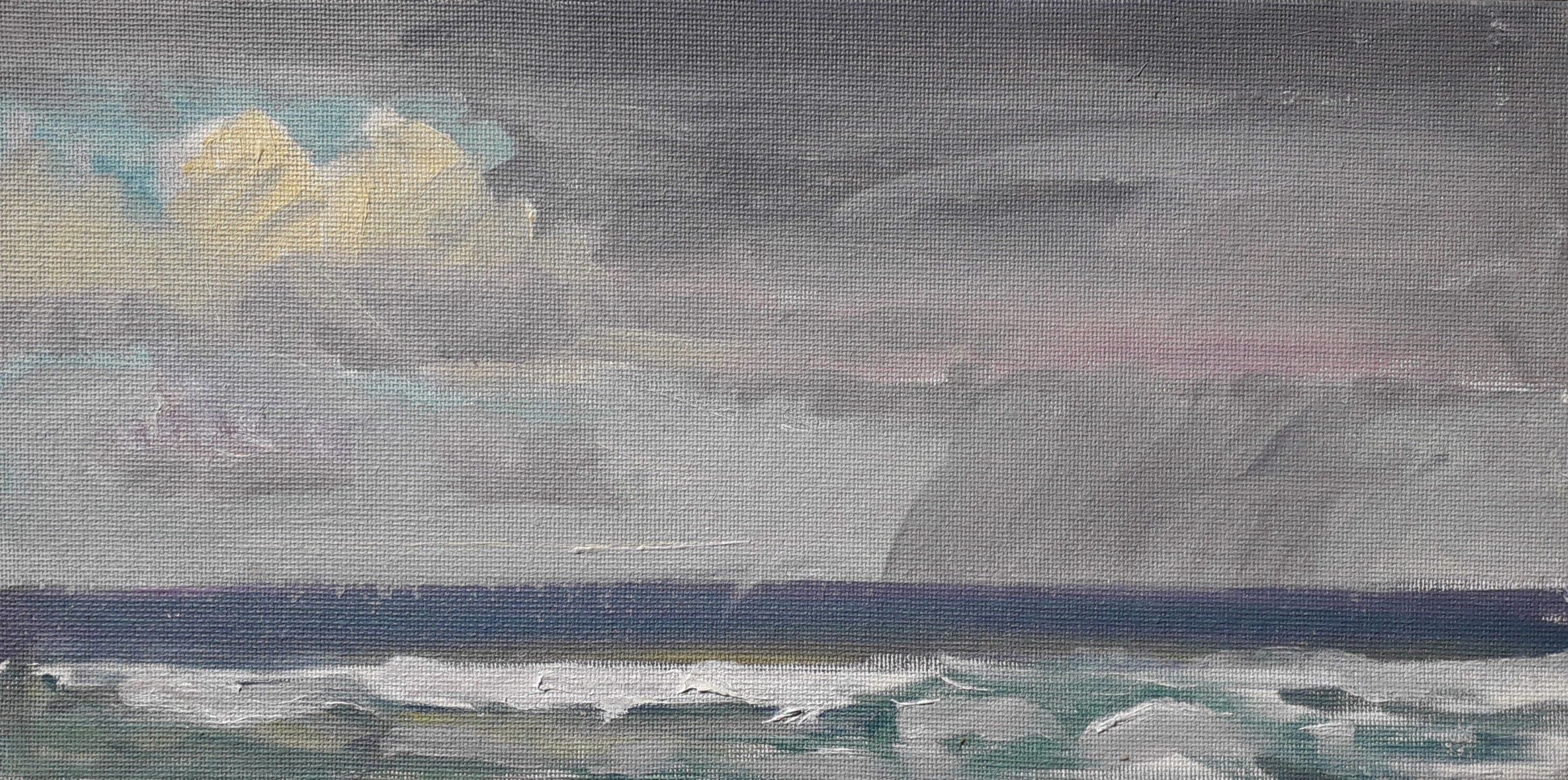
Soon, however, it’s just me staring towards Gansbaai, trying to figure out those shades of aquamarine in the rapidly-changing light.
The cloud on the horizon gets steadily closer, and I pull out a little 15 x 30 cm canvas panel, putting down some dashes of colour as the rain drifts in. Suddenly I’m having a true plein-air moment: wet paint all over the show, rain dripping from the brim of my hat, gathering together my stuff and scuttling for cover. It’s quite exhilarating, this fresh air business. I think I’ll be giving it another go.
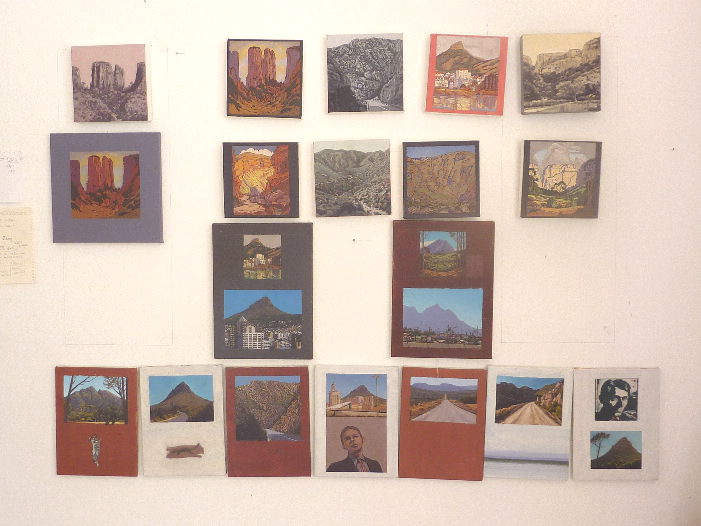
'n hele klomp kleintjies
The September exhibition date looms. Many of the chickens have come to roost at one end of the studio, quietly bothering me. The painter Simon Stone was once asked “when is a painting finished?” “When it stops irritating me ” was his answer. The business of finishing is just that, a slow burnishing away of faults.
The square ones at the top are 20cmx20cm – part of a set of twenty. The bottom row of paintings are an old standard size: 9×12 inches. They’re done on Belgian linen, made up in Jo’burg about seven years ago. At last, the right moment and the courage to paint on them! Belgian linen is the holy grail of paint surfaces (particularly oil primed BL).
Mostly, when a work goes as “oil on canvas”, it is something called “cotton duck”, an inexpensive and durable support, but not as smooth as BL. It’s only when you’re really making good money that you’ll be ordering Belgian linen from your canvas makers (as Robert Hodgins unfailingly did). Meanwhile I’ve had a bad run of it with canvas suppliers, so I’ve resorted to stretching a few of my own. For the first time in about 15 years.
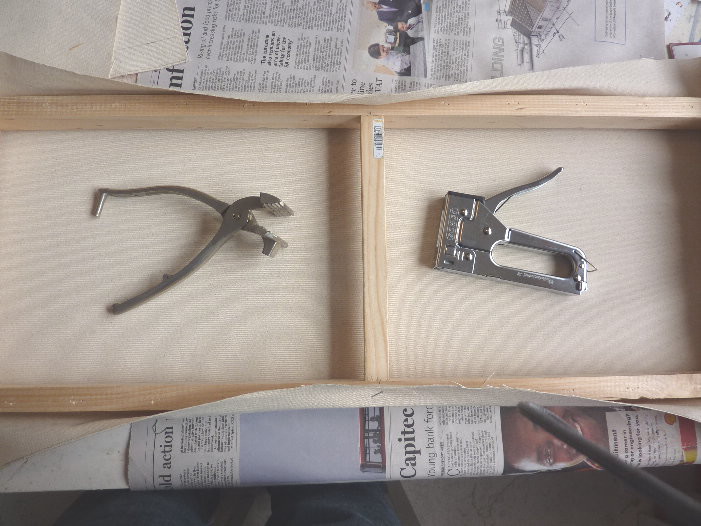
behind the scenes
You need a stapler and, unless you have a particularly strong pair of thumbs, a purpose built canvas gripper. This is a good thing to do on a Saturday afternoon. I recommend the boeremusiek programme on RSG as audio accompaniment, but that is optional. The trick is to get it stretched tight, but not too tight. You should only take tea whilst doing this. Definitely no liquor. That will count against you when it comes to the folds on the corners.
With that behind me, I still had the problem of wanting more small Belgian linen canvases to work on. (You get addicted to the feeling of the brush gliding effortlessly over the surface, you understand.) My quest took me to The Italian Shop in Rondebosch. The proprietor, Angus Kennedy, is a mine of information and an hour later I left clutching the beautifully made up 9×12 linens as well as a whole lot of stuff I hadn’t really thought I’d be buying. Like this beautiful 60ml tube of artist’s quality Cadmium Red from Maimeri. At R360 a tube, I rate this a buy. You can get through a lot of 9×12 size canvases before you squeeze out the last bit of this pigment.
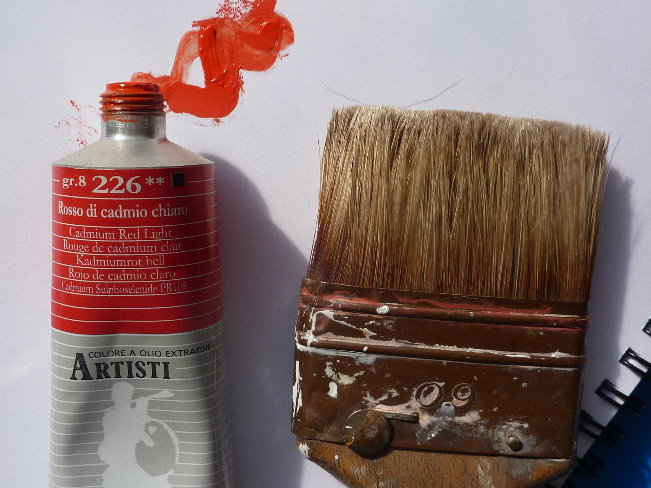
Cad Red
I took a spin to Camps Bay to look at Rose Korber‘s annual Summer Salon, an event that has been on the Cape Town art calender for the past 19 years. At Rose’s fine Camps Bay home you’ll see works by some of our trusty old campaigners (Kentridge, Nhlengethwa, Hodgins, Bell) as well as some newer kids on the block. I admit to a certain bias in favour of my guitar compadre Richard Smith, his quadrangle of works had a certain authority:

Smith interrupted by Willie Bester
The walls are packed with work, and if you’re looking for the crisp clean lines of the modern gallery, this isn’t it. What you find here are unexpected gems, and a mix of new and older work: A set of six Hanneke Benadé pastels, a 1997 Simon Stone, a fine little Debbie Bell lithograph. The Prime Minister of South African art was also strongly represented: sets of “Nose” etchings and a very fine set of new “West Coast” etchings.
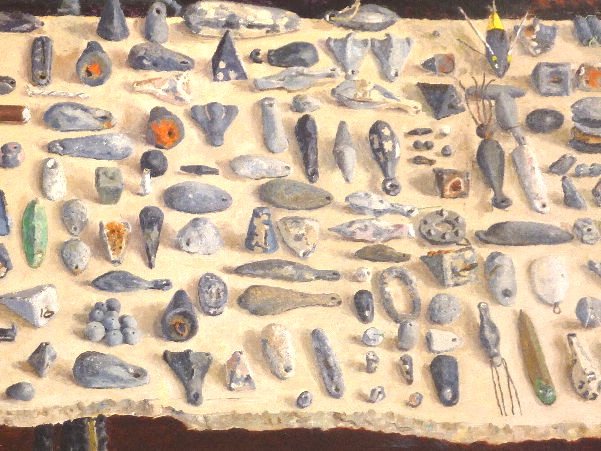
Detail, Simon Stone "sinkers"
From Mr Stone’s obsessive sinker – painting days. The thing about these paintings for me is the crazed commitment to the act of observation where the painter sets out to prove the idea that painting can transform the most mundane of things. And succeeds.
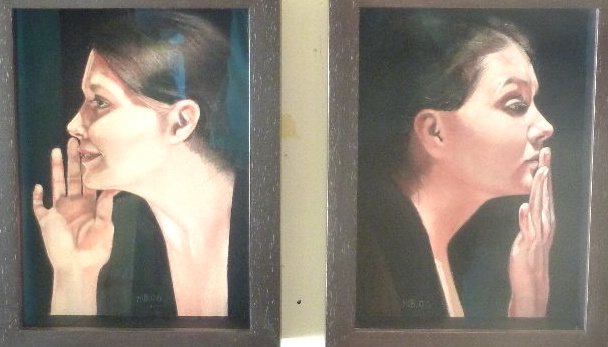
"Skinner" - Hanneke Benadé
I can never stop myself going up close to look at Benadé’s pastels. They’re so bloody immaculate! With a medium that lends itself to bright saturated hues (brilliantly used by Zwelethu Mtethwa), Benadé has moved over the years to making rich, meditative works that seem close to Seventeenth Century Dutch painting. In the stairwell there were some oils by Colbert Mashile, a young and promising painter of enigmas whom I like.
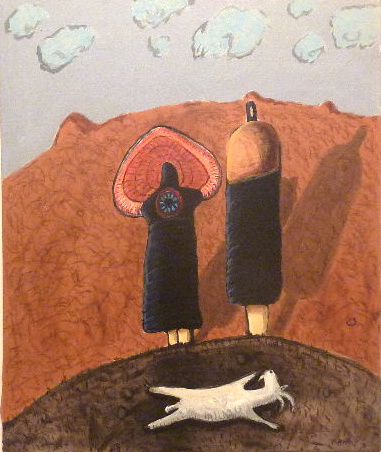
By the way, Rose told me that sales could have been better. What’s going on here, all you investment bankers? The days of stock markets are over – your money will probably outperform in art – and it’ll be a lot safer! Koop kuns mense!

 Travels with Pierneef