You are currently browsing the tag archive for the ‘Klein Karoo’ tag.
Winter in the Klein Karoo. I am walking through open country, towards the Touws Rivier. The beechwood easel is slung over my shoulder and little Cleo is trotting up front. I’m heading for a small cliff that I may like to paint. It feels right, moving through the stones and scrub, with the odd cloud scudding overhead. It takes a while to settle on something – I am spoilt for choice and can’t decide. There’s no water in the river, and the riverbed is what I settle on. The view up the riverbed, with the stones and the dark shadow under that acacia tree is what catches my eye.
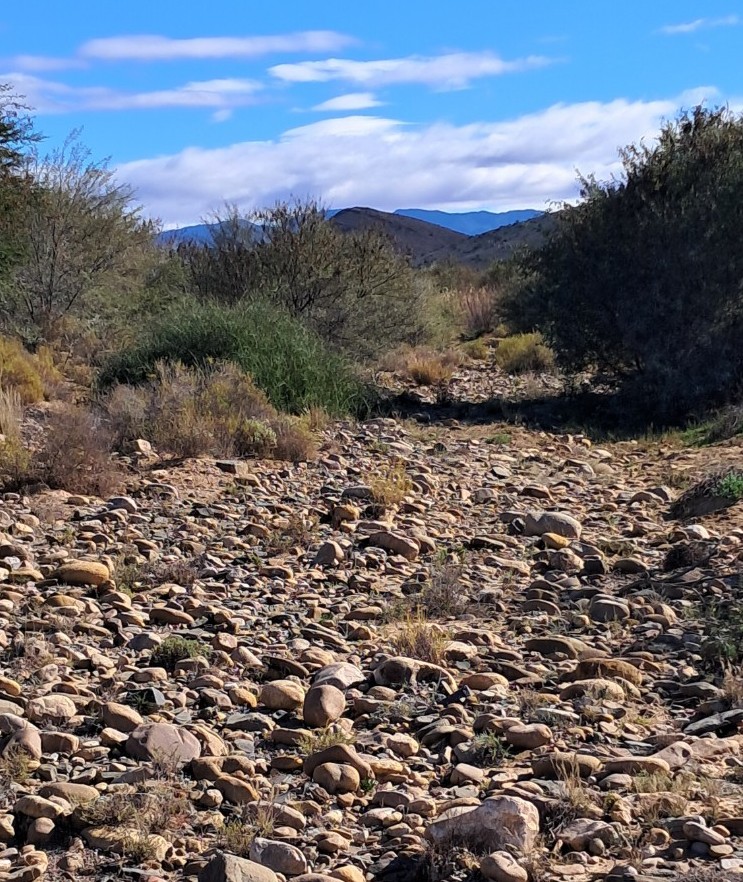
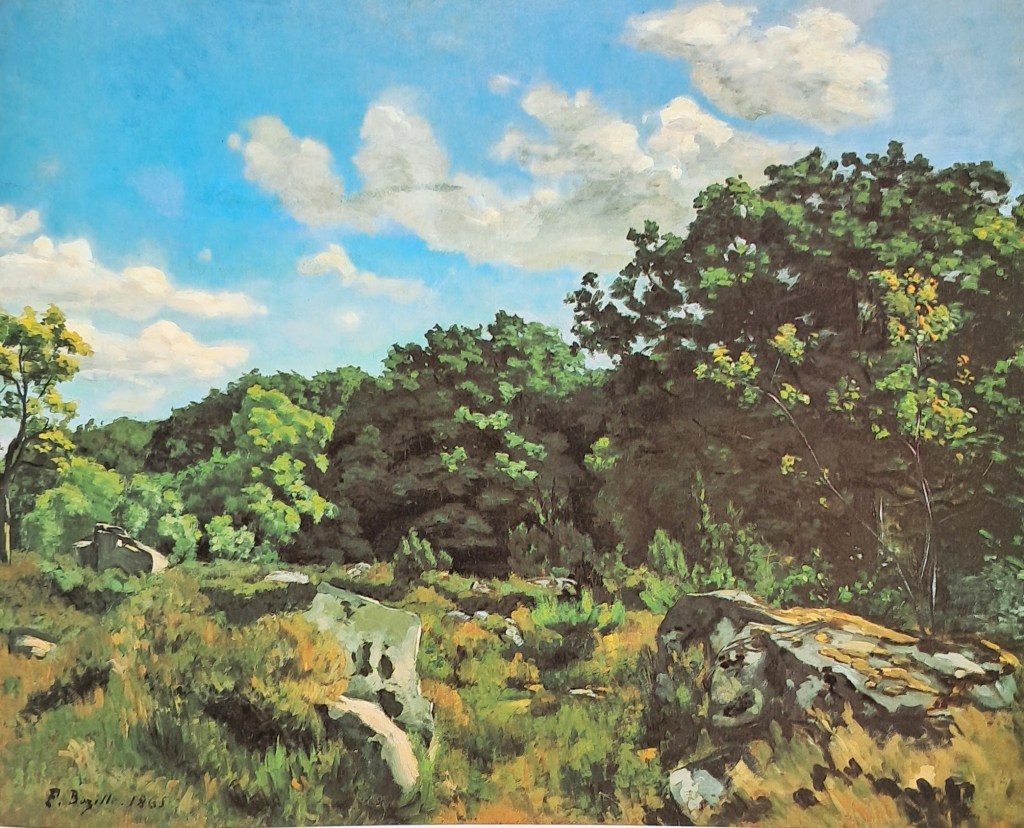
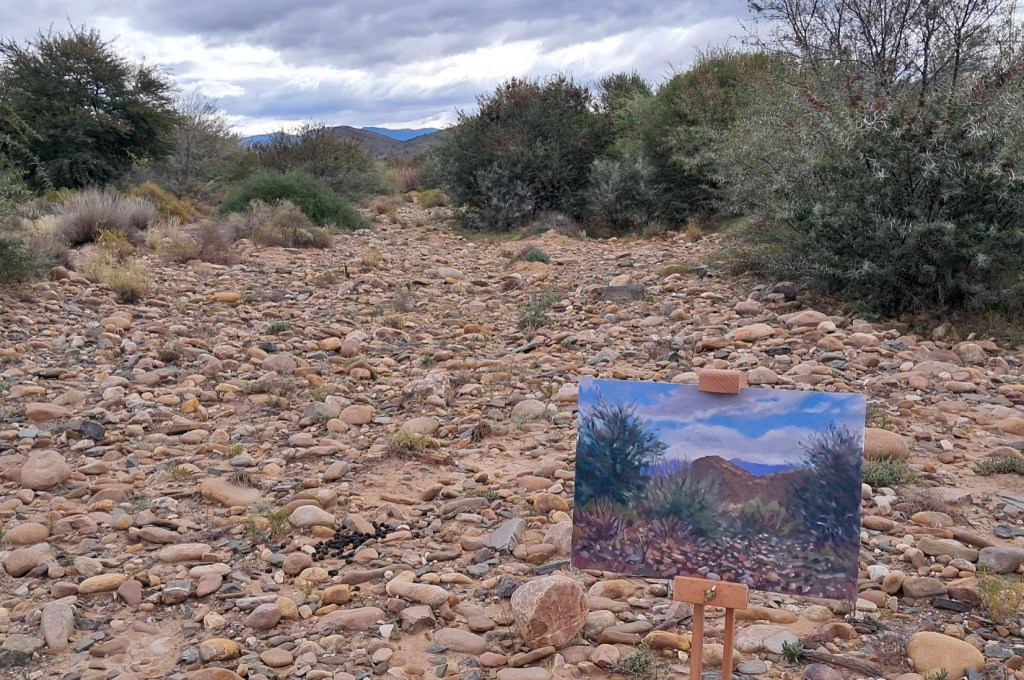
I clear away some of the pebbles and start to inhabit my painting space. As usual I have no real idea of how to proceed. The main thing is to get going, so after emptying the tea flask, I lay in some of the darker shapes. It’s always this: big shapes to smaller shapes, dark tones first, hang on to the bigger brushes as long as possible. I have no further method, and after an hour or so I’ll be involved in all sorts of unexpected improvisations, fending off disaster. The difficulty of this plein air thing is all too apparent in my clumsy first steps. I cling to the sense that I can get this right – with only a vague notion of what that looks like . Whilst painting I’m haunted by images I hold in my mind, by artists who are both daunting and inspiring. Obscurely, today I’m thinking about a Nineteenth Century French landscapist called Frederic Bazille. The landscape at Chailly (below) was done in in 1865. Monet, Sisley and Pisarro, amongst others, were all experimenting with plein air painting at that time, but the full – on Impressionist phase of broken brushwork was still to come.
As I paint, a cold front sneaks in from the South. The light is much more diffuse now. This is not necessarily a bad thing, but it’s kind of different to how it was an hour ago. That dog of mine has started wandering in ever wider circles, and so is my concentration. Time to pack it in. Maybe later on in the studio I’ll be able to work it up into something acceptable…..
Back up the pass from Prince Albert now, sketchbook in hand. On both sides of the road there are outrageous rock formations, shaped by mighty forces:
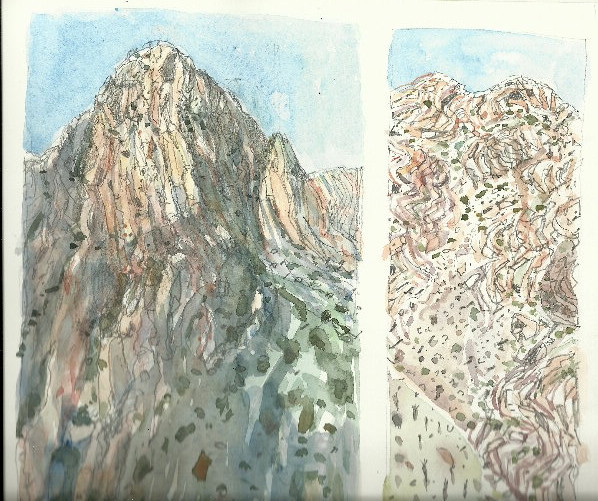
I get to the site around 12.30 and settle in. A lot of the sites I’ve been to have changed since Pierneef painted them, the landscape encroached upon by highways or housing. But this is unchanged since Thomas Bain and his crew hammered their way through here in 1886. The year of Pierneef’s birth. (And Johannesburg’s too)
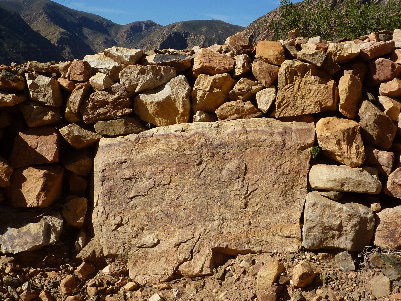
built to last:stonewalling at the site
But the gravel road is showing the wear and tear of fairly high traffic volumes, so while I’m doing the watercolour I make a list of the passing traffic: Fortuner, Isuzu, Land Rover, Toyota sedan, 2 cyclists, Suzuki, Bakkie, two Dutch people in a small car, Correctional Services Toyota, Poephol in a Prado, CA Yaris, Silver merc, Silver Toyota, White Toyota, 2 cyclists at speed, Landcruiser, Party of 8 cyclists, Isuzu bakkie van Bredasdorp, Kia, Colt with a Staffie, Big yellow truck (12.30 – 4.30pm). The cyclists, by the way, had pedalled over from the Oudtshoorn side and after spending the night in PA were coming back over the next day. Eina.

I haven’t seen my old friend George for a while but clearly the heat and pace of life in Prince Albert continues to do him good. Not too long after moving into his new house, he bought an old barn across the road that is now his studio. Here he cultivated a true Karoo garden from cuttings acquired on his daily walks through the veld.
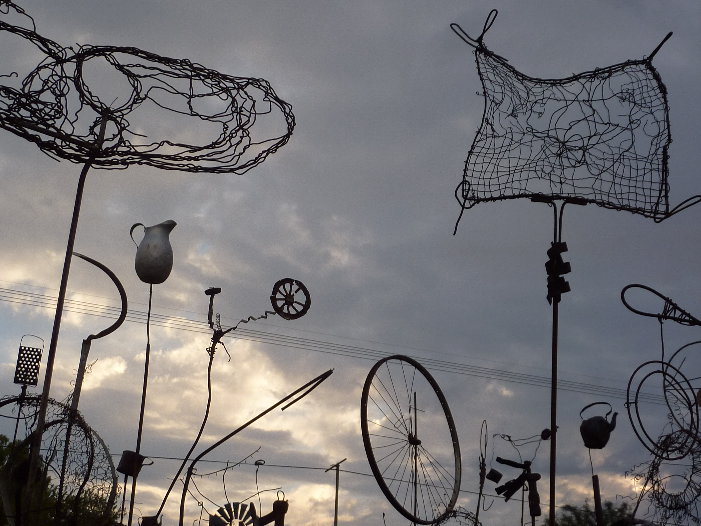
the waterwise karoo garden
One is confronted by hundreds of discarded metallic items, some of them domestic objects, others of baffling provenance. Some have retained their original identity, others have been combined to make surprising new forms. The installation continues….
hot off the press
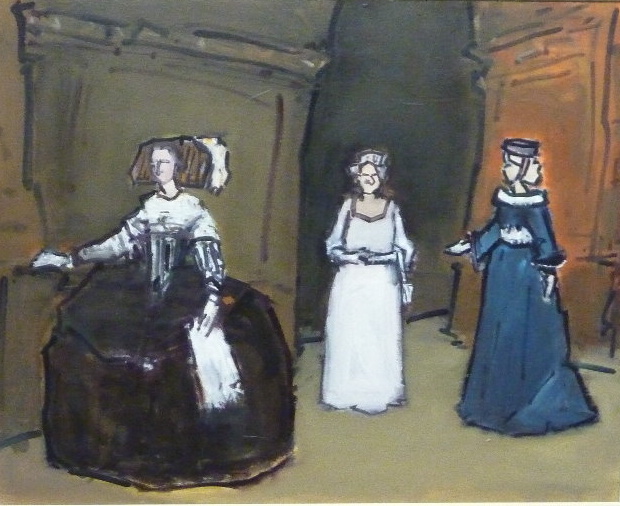
Inside, George is applying the finishing touches to a small canvas. Its called “Barbie meets the Queen.” That would be Barbs on the right, HRH in white and a terrifically grandiose damsel on the left who may have just exited a Velasquez painting. Is she the real queen? What’s going on here? I forgot to ask while I could. I was too busy admiring the silky washes of paint and the deft economy of line. In his world, figures from the Old Masters or 1960’s comics may find themselves in the jungles of the Congo as he wryly revisits his colonial youth. And with charcoal in hand, George has few peers. If you want to get a Coutouvidis, you have to make sharp. They sell out of the Prince Albert Gallery as soon as he delivers them.
So there’s no site. But I’ve got a tea date with George and Sheila Coutouvidis and I start the downhill glide. Its 20 kilometres of downhill all the way to Prince Albert. I took the bicycle ride down a few years ago. You pay a guy in PA to take you up in his shiny Toyota. {Make sure your bike brakes are in good working order.}
This is what I’m looking for:
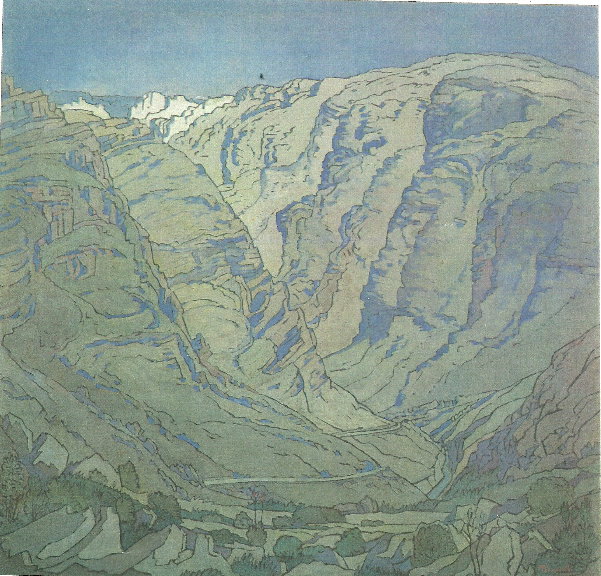
"Swartberg Pass" J H Pierneef c 1930
It’s not one of his best panels. We get a sense of the size of the mountains, but there’s no drama here somehow. There’s a lack of illumination, no light source. The key to finding the site is the road of course. It curves around two hills, and there’s a hint of a river just off to the right. I’m halfway down the pass already and I happen to glance to my right and there it is:
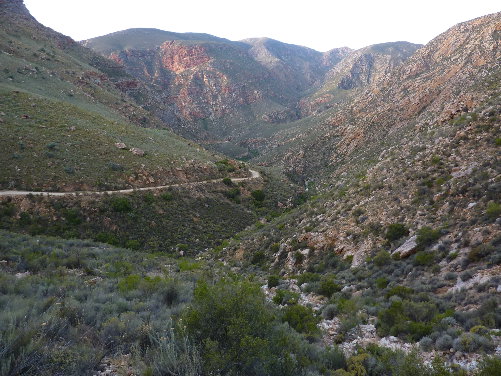
at last!
I stop the car and let out a yell (as one does when finding a Pierneef site.) I’m in exactly the right spot. It’s about 3.30pm and there’s no direct sunlight anymore. That explains the lack of light too. Fantastic. But now I’ve got to go and have tea with George and Sheila. (Double click the pic and you should be able to see the second curve of the road clearly.)
Three years ago I looked on the North side of the Swartberg Pass for the Pierneef site – nothing doing. Its definitely on the south, or Oudtshoorn, side. I take a farm road. No traffic, no cell reception, not much of a road. Probably pretty much how it was for Pierneef in the 30’s.
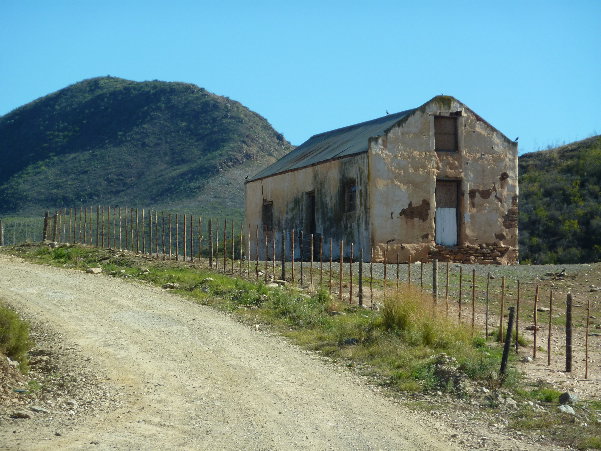
eensaamheid in die klein karoo
You take it slowly on a dirt road, and that makes you look at where you are. I’m looking at some pretty big mountains, feeling suitably insignificant. I’m sure I’ll find the site near the bottom of the pass, but I don’t. I do a watercolour and carry on up.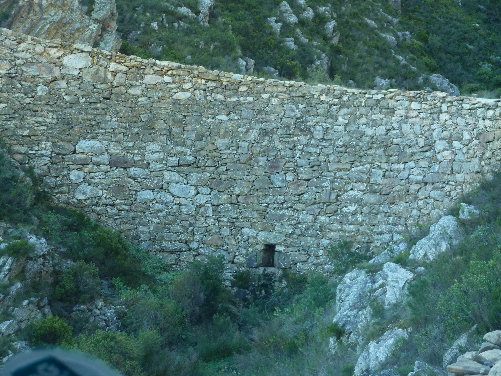 There’s nothing that looks vaguely like the place I’m looking for, but the Pass is stunning, something new around every corner. Quite near the top I have something to eat and do another watercolour, then head to the top. There’s a fierce wind , so I stay in the car and do a third little watercolour sketch.

view from 'die top'
OK. I’ve got a page of watercolours but no idea where the site is. Perhaps he made it up?
From De Rust you cross Spookdrif, Skansdrif, Damdrif, Boesmansdrif, Skelmkloofdrif, Aalwyndrif, Nooiensboomdrif and there it is, Dubbele Drif se draai:

jh pierneef. Meiringspoort
Following the curve of the road, this is the right place. It seems as if the river’s on the right, but if you look closely its running onto the road from the left. The river now runs under the road. And that large boulder is indeed there. Because of the new bridge, I can’t get as close as he was, so the cliffs seem less towering. The light coming in from the east tells me he was here early on a summer morning. At this time of year it only gets a touch of late afternoon light.
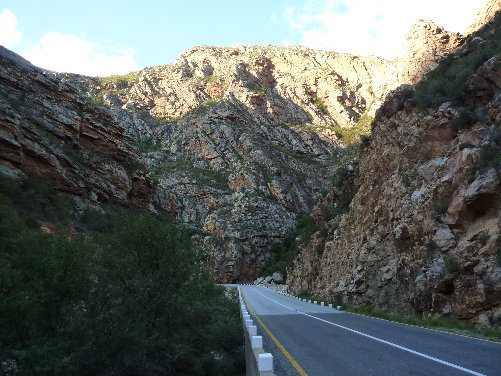
Dubbele d se draai, 2010
I’m glad that the decision about what to paint in the Poort has already been made for me, because there’s a bewildering majesty to this place and I wouldn’t know where to start. But that thing I said about the silence isn’t strictly true. There are quite a few big trucks winding through here. And some of them like to hoot at the weird oke in the hat painting next to the road, which makes me jump.
The famille Niehbuhr takes their leave and I’m alone in the old karoo house. If you go to the front stoep in the morning, you’re likely to find its lunchtime before you know it.

Hermann se plek
I head straight for the Poort. The road follows the river beneath giant crumpled cliffs. In summer the heat will knock you down, but in early winter there’s a clarity and stillness to this place that astounds me.

cowboy country?
Way down there in Hermanus the rain and cold is coming in and on the R62 it’s light and warm and cloudless and I can feel my winter coastal depression lifting as the road winds ahead.

is daaie die swart of blouberge?
 In De Rust in the late afternoon there’s a donkey cart clattering down the main road. A tiny khoisan woman bearing a large pumpkin comes down the hill and tries to sell it to me. She’s lurching a bit, not only from the weight of the pumpkin. There’s a bloke hovering in the background. The pumpkin is the best thing that’s happened for some time, and its probably going to end badly. Slightly unsettled by this reminder of the abject state of our first people, I meet Hermann’s son Thomas and his American grandparents. They like the Klein Karoo, are puzzled by the ‘German speaking brown people’, and have an unnecessary fear of encountering a Cape Cobra.
rustic nirvana
(Double clicking on any photograph gets you an enlarged version)

 Travels with Pierneef