You are currently browsing the tag archive for the ‘Cape Town’ tag.
And so to the West Coast for a short break from the rigours of life in the Overberg. It’s a family outing – the good doctor and new pup Cleo are on board. The open road lies ahead! My late aunt Gisela, a staunch Capetonian, never had anything good to say about the West Coast. As we traverse the outlying industrial wastes of Cape Town and the scorched earth wheatfields towards Malmesbury, I have to agree with her. Close to the West Cape nature reserve we catch sight of some giraffe leaning into the wind near the road. They strike me as anomalous, out of place. They should surely be browsing the leaves of tall acacias, not scrubbing it among the treeless fynbos. After all, it was only much closer to the Gariep River, way to the North, that Francois le Vaillant encountered his first Cameleopard, which he promptly shot and skinned. But I digress.

Fifteen kilometers before Paternoster is the town of Vredenburg. It is surprisingly large, the coastal equivalent of say Newcastle or Rustenburg, with an extensive, abject shack settlement rolling over the parched hills. Where did all these mense come from? What the hell are they doing there? Closer to Paternoster, there are clumps of huge rounded Stonehenge – type boulders jutting out of the earth, the only thing in sight for the eye to fix upon. Pods of sheep dot the barren wheatfields, while crows circle overhead. Never a good sign that, when crows are the only birdlife.
Coming in to Paternoster, there’s no “wow” moment, no indicator that we’ve entered the idyllic realm of fishing boats- on -the -beach, as depicted by many a local artist. Having brushed off several loud crayfish salesmen of the street, (Kreef! KREEFFF!!) we find ourselves in a comfortable flatlet, surrounded by white houses in a faux-mediterranean style. They have names like “Duintjie” and “Strandloper.” There’s a strict aesthetic conformity here. Voelklip, where I live, is an architectural calamity: kak facebrick houses, grandiose concrete bunkers, this and that. I’ve always thought strict aesthetic controls would have been a good idea but now I’m not so sure: this place looks too much like, well, a theme park. With old fishing boats strewn on every other corner to give it authenticity. The wind is blowing and yes, your aging artist sees nothing to sketch and is grumpy.
Next day, we find out a bit more about Paternoster. The original inhabitants, mainly coloured fisherfolk, woke up one day to find white people offering wads of cash for their cottages. They took the cash and next thing they were on the street with large nouveau- Greek houses going up around them. Fancy eateries too. ( Kreef! KREEFF!!) But the fisherfolk smartened up and stopped selling their houses. So now, uniquely in South Africa, there’s an interesting mix of class and culture, as the rich bastards are cheek by jowl with the hardscrabble fisherfolk. Across the way from the Paternoster Hotel, (an authentic – looking place, by the way,) there’s a group of Kreef sellers. They gather every morning under the shade of the bloekombome. It is thirsty work on these hot summer days, and the manne keep quarts of beer close at hand. They joke and jest loudly, en hulle vloek mekaar lekker. I did a little sketch of that scene, thinking that a real artist would go right in there and do a series of portraits of those fellows. Francois Krige, perhaps, would have risen to the occasion.

There’s a Paternoster waterfront, better than the Cape Town one. It’s a warm day but under the shade it’s just right and, surrendering to the boats -on-the-beach cliche, I get on with a little watercolour. I’m working on 300g hot pressed paper and mixing in a bit of gouache. My painting gear is simple and portable: everything I need fits in the satchel. The sea is flat and iridescent and there are those beautiful big luminous rocks out there. The sculptor Henry Moore would have cried to see those. Everyone here is relaxed and in browsing mode, so I get several onlookers. I’m happy to interact with them and hear their stories. I meet a man from Namibia who is finding his extended family who came from the West Coast. Also a few watercolourists from England. They are polite and encouraging. I’ll take any morale – booster. After all, plein – air work is mostly destined to fail and disillusion always lurks. There is a German man too. ” Ah, malerei,” he says, surveying my handiwork. ” Ja, very good. Und such a light equipment too.” How very Teutonic, to asses the means as well as the result! Thanks my broer. We live to paint another day…..
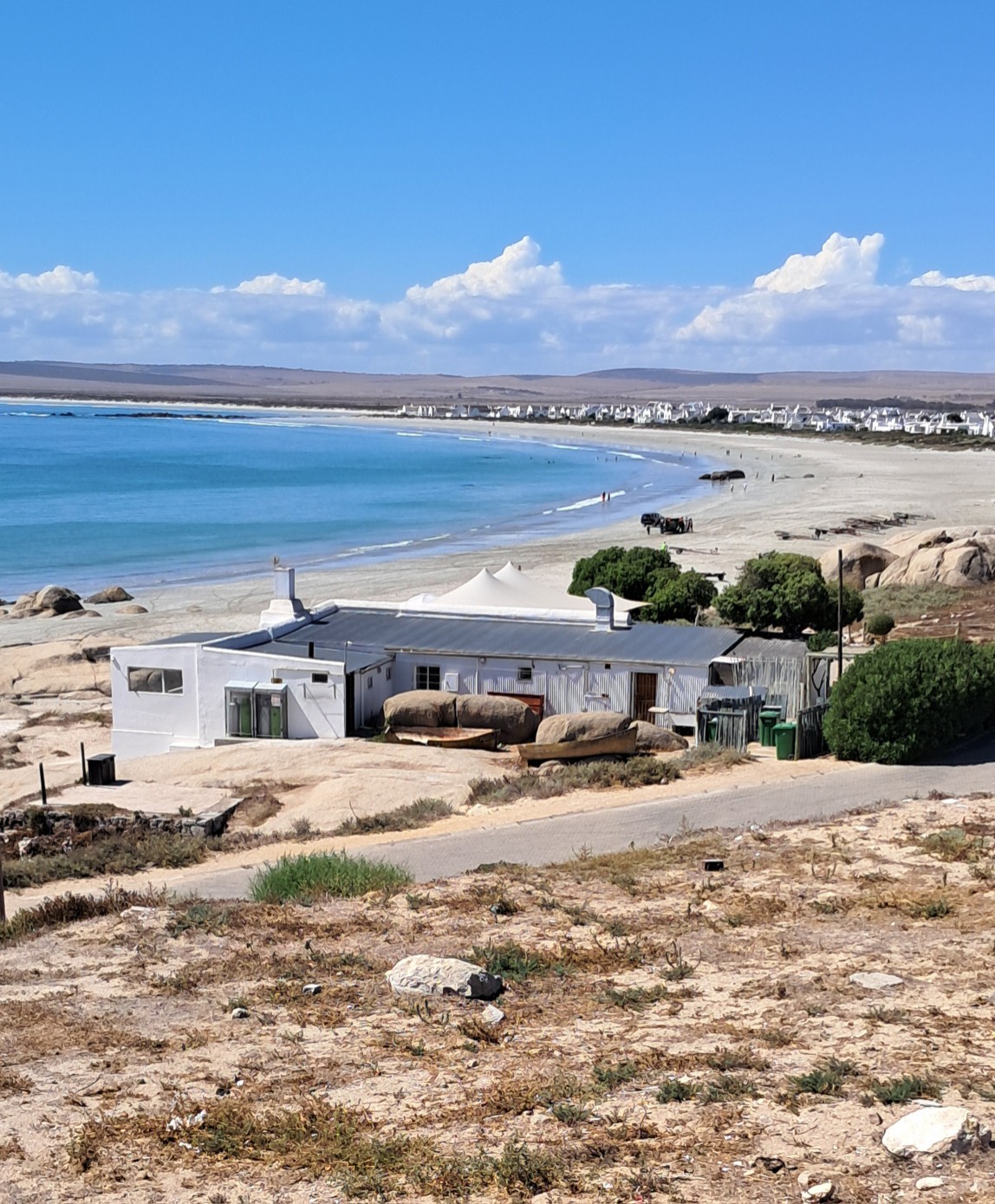
Portjie pic
OK. So its been a while since I posted anything. Needless to say, my blog coach and I are no longer on speaking terms. She fired me. I told her that the pre-exhibition painting frenzy is antithetical to the idea of putting yourself out there in words, but she was having none of that. It was a lie anyway: There hasn’t been any painting frenzy. Instead, your painter has been sinking in a quicksand of incessant domestic trivia while his career slowly goes down the plug. As an antidote, I headed for Cape Town to look once more for the elusive Lion’s Head site.
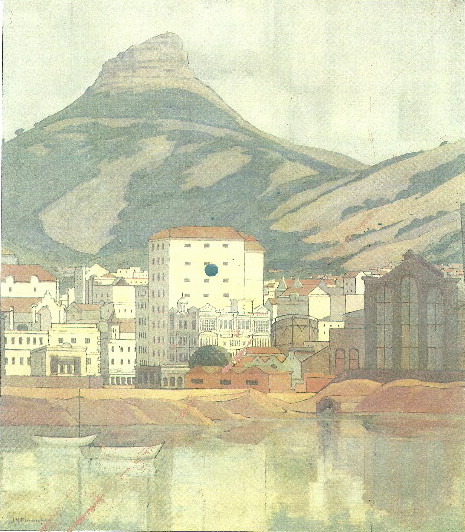
J H Pierneef. Lion's Head. Oil on canvas
My first search for this site took me near the waterfront, and I ended up in the offices of Transnet down by the docks. (Transnet, coincidentally, are the owners of the Station Panels.) A man told me that the reason I couldn’t find this site is that it no longer existed. In the 1930s this had been the Roggebaai Harbour, and it had been reclaimed in the 1940s. There is a picture of this view in reverse:
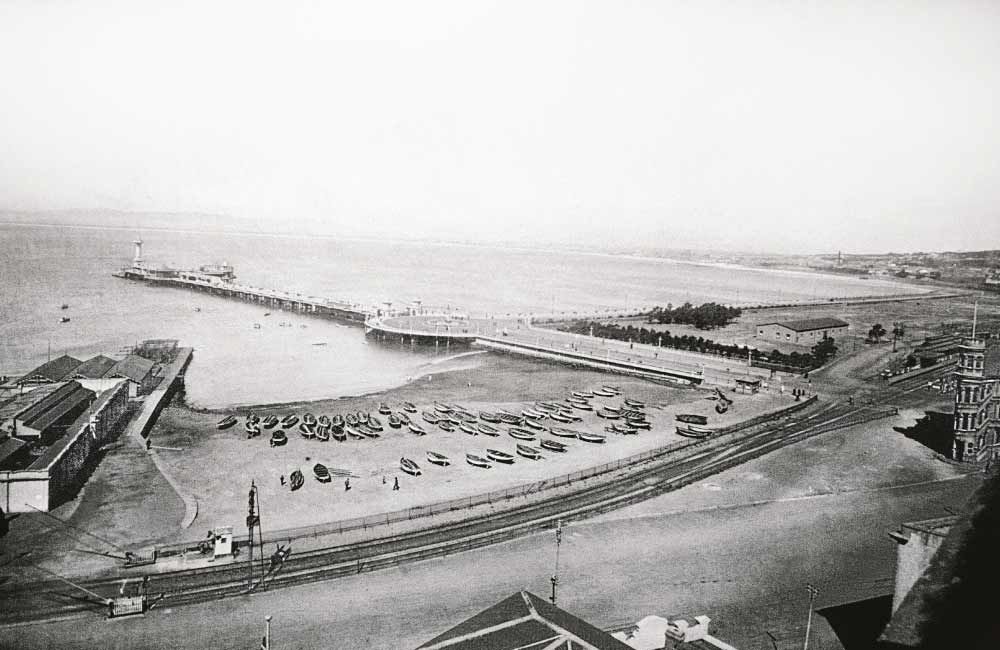
the reverse angle c 1930
Those boats and the warehouse roofs on the left clinch it as far as I am concerned. Pierneef must have taken his view of Lion’s Head from drawings done on the pier. Today this is in the vicinity of the Dias Circle, in Lower Heerengracht Road, near the monster called the Convention Centre.
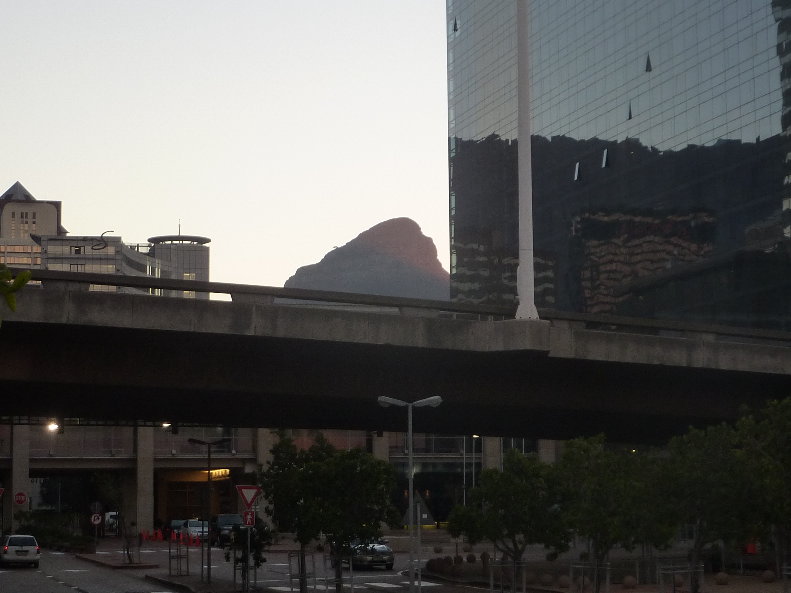
not a lot
There isn’t a lot of Lion’s Head to be seen from this neck of the woods, and although I reckon one can conjure a meaningful painting from just about anything, this didn’t do it for me. I needed elevation, and so the next day after having breakfast with my old studio china Dave Rowett, we headed for a roof. I spent a lot of time painting from roofs in Jo’burg, but this was my first Cape Town roof. The Metropolitan building stood tall in the line of sight. The security guy let us in after a few questions. “Net nie spring nie kerels, dan is EK in die kak!” We went up to the 26th floor. It was the shortest day of the year, but balmy and cloudless. The profile of Lion’s Head seemed to perfectly match the original painting. Below us stretched a jumble of Post Modernist structures, but no trace of any of Henk’s buildings. We doodled on sketchpads whilst the panorama of Table Mountain lay resplendent before us. This job is hell, dear reader, but somebody has to do it.
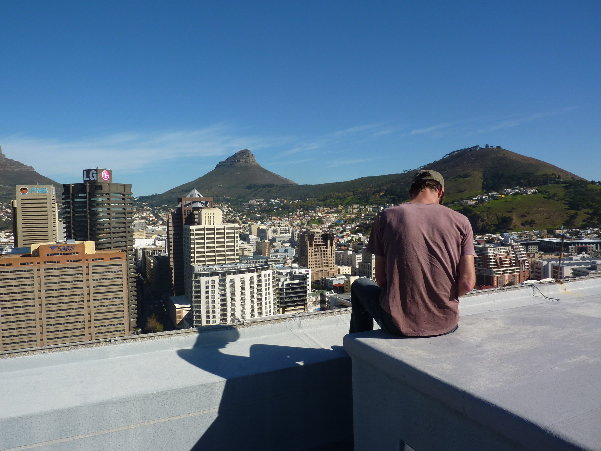
Damaraland Dave on the 27th floor
I don’t know what the hell happened to that last post! It’s Sunday night and I’m getting irritated, so here’s a quick look anyway at the full painting, at the point where it gets really interesting.

the long shot
Two little views of the Leeu se Kop, the one in the Bo Kaap in February, sweating in the afternoon sun. The other done in March on a nondescript Saturday afternoon. Edward Hopper – a superb watercolourist – was fond of taking a watercolour from behind the frame of the windscreen.
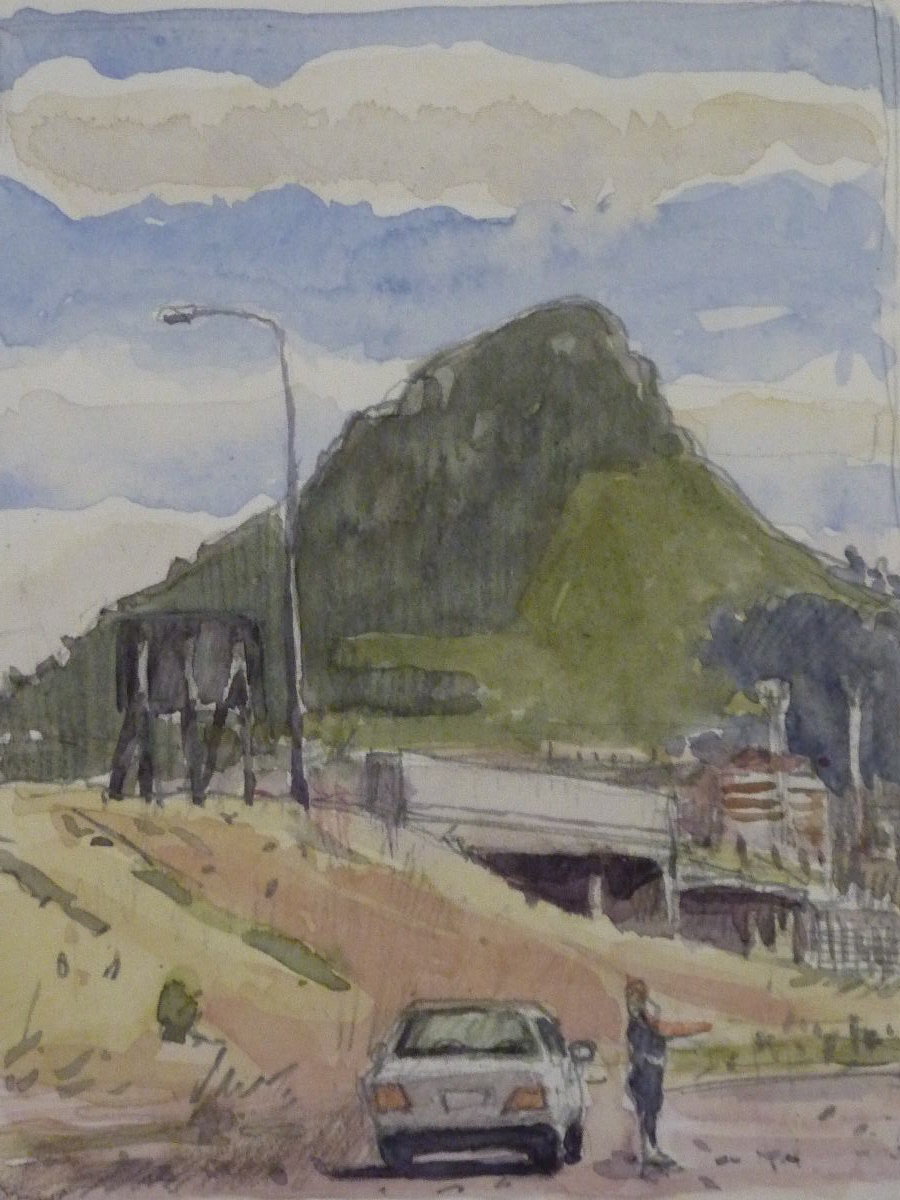


Since our man often combined different views in a single image, (like the exaggerated buildings in the Hermanus panel) I figured in the Lion’s Head panel he’d done the same. So I started close to it and worked my way backwards to the water and the Postmodern malaise down by the docks….

Lion's Head (with a Damien Hirst dot)

scratching around...

 Travels with Pierneef