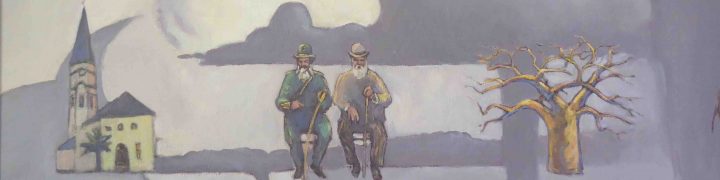
I haven’t seen my old friend George for a while but clearly the heat and pace of life in Prince Albert continues to do him good. Not too long after moving into his new house, he bought an old barn across the road that is now his studio. Here he cultivated a true Karoo garden from cuttings acquired on his daily walks through the veld.
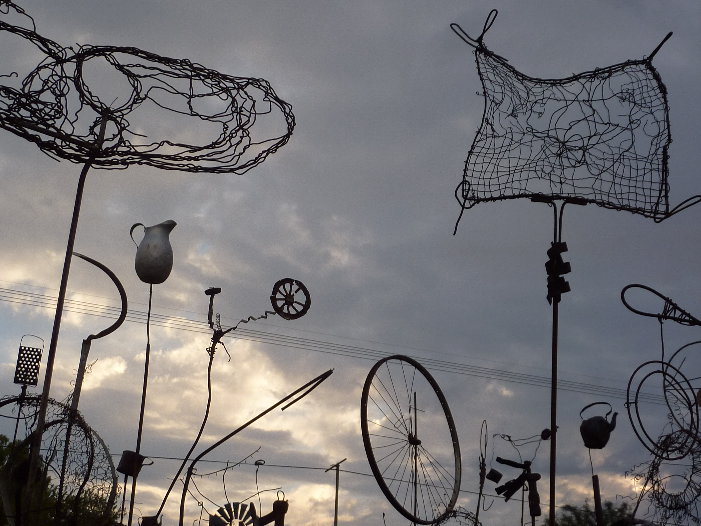
the waterwise karoo garden

One is confronted by hundreds of discarded metallic items, some of them domestic objects, others of baffling provenance. Some have retained their original identity, others have been combined to make surprising new forms. The installation continues….
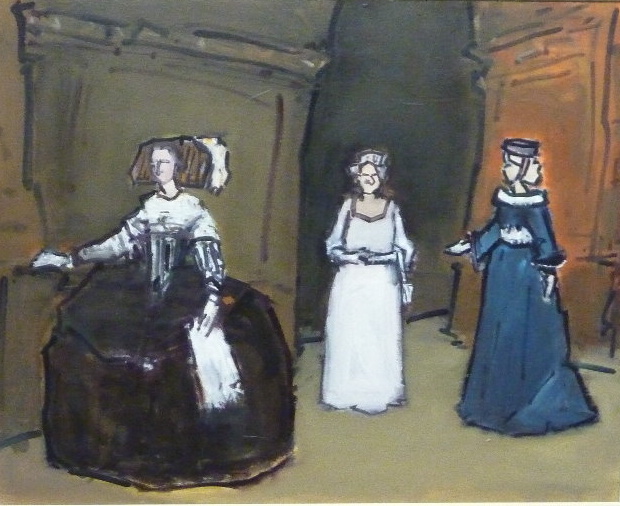
hot off the press

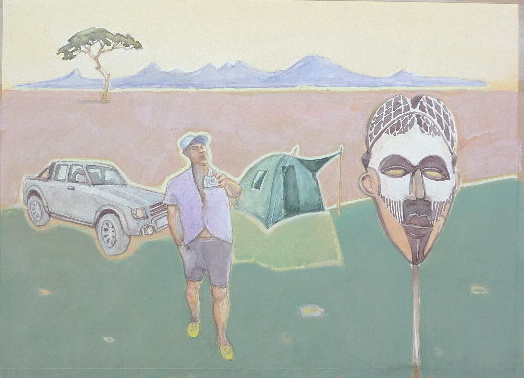
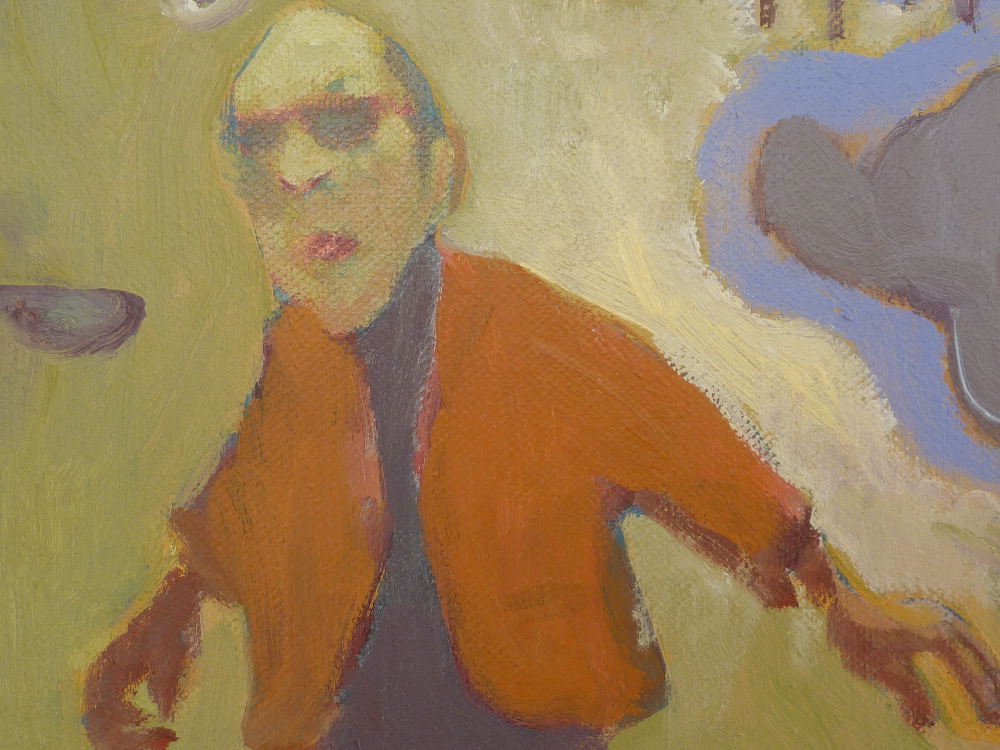
Inside, George is applying the finishing touches to a small canvas. Its called  “Barbie meets the Queen.” That would be Barbs on the right, HRH in white and a terrifically grandiose damsel on the left who may have just exited a Velasquez painting. Is she the real queen? What’s going on here? I forgot to ask while I could. I was too busy admiring the silky washes of paint and the deft economy of line. In his world, figures from the Old Masters or 1960’s comics may find themselves in the jungles of the Congo as he wryly revisits his colonial youth. And with charcoal in hand, George has few peers. If you want to get a Coutouvidis, you have to make sharp. They sell out of the Prince Albert Gallery as soon as he delivers them.
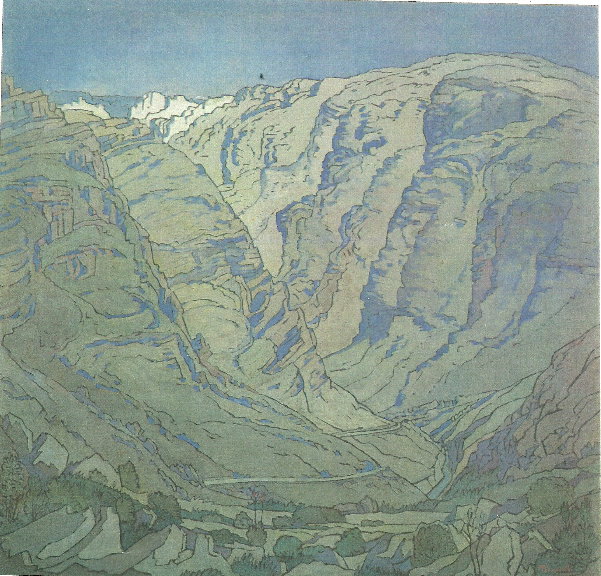
So there’s no site. But I’ve got a tea date with George and Sheila Coutouvidis and I start the downhill glide. Its 20 kilometres of downhill all the way to Prince Albert.  I took the bicycle ride down a few years ago. You pay a guy in PA to take you up in his shiny Toyota. {Make sure your bike brakes are in good working order.}

This is what I’m looking for:

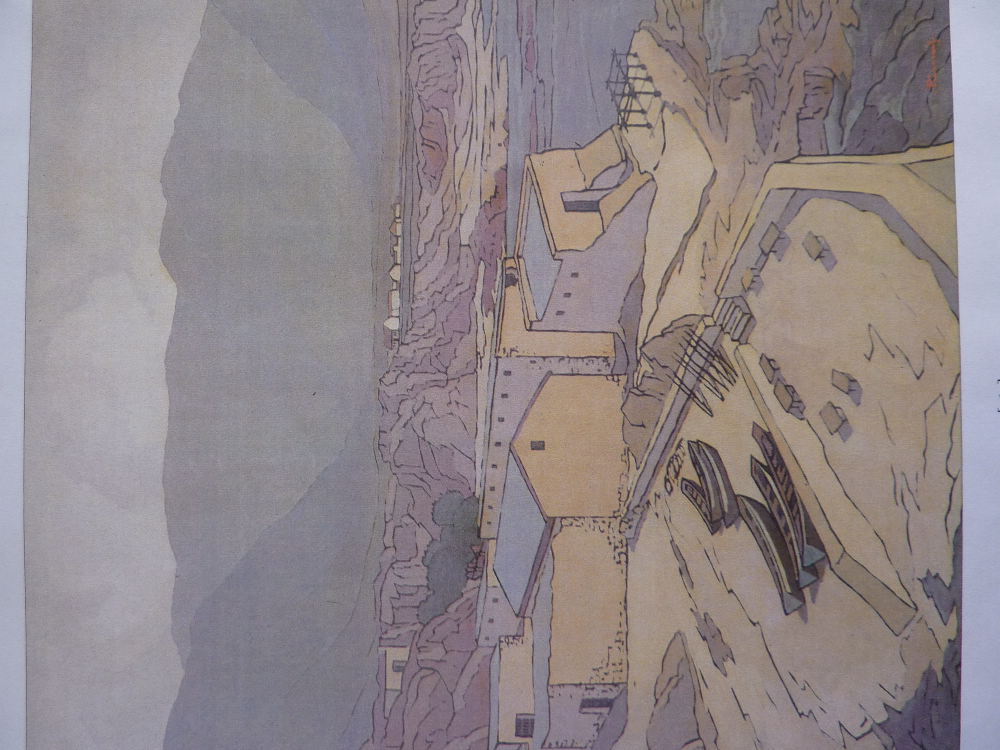
"Swartberg Pass" J H Pierneef c 1930

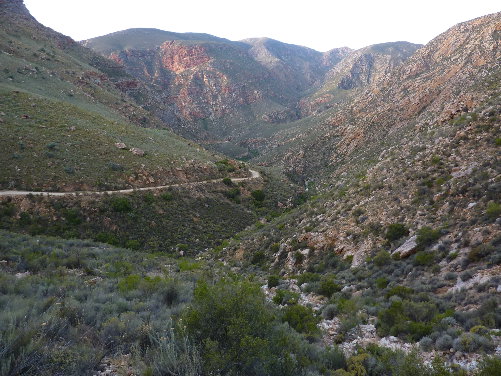
It’s not one of his best panels.  We get a sense of the size of the mountains, but there’s no drama here somehow. There’s a lack of illumination, no light source. The key to finding the site is the road of course. It curves around two hills, and there’s a hint of a river just off to the right. I’m halfway down the pass already and I happen to glance to my right and there it is:

at last!

I stop the car and let out a yell (as one does when finding a Pierneef site.) I’m in exactly the right spot. It’s about 3.30pm and there’s no direct sunlight anymore. That explains the lack of light too. Fantastic. But now I’ve got to go and have tea with George and Sheila. (Double click the pic and you should be able to see the second curve of the road clearly.)

Three years ago I looked on the North side of the Swartberg Pass for the Pierneef site – nothing doing. Its definitely on the south, or Oudtshoorn, side. I take a farm road. No traffic, no cell reception, not much of a road. Probably pretty much how it was for Pierneef in the 30’s.

eensaamheid in die klein karoo

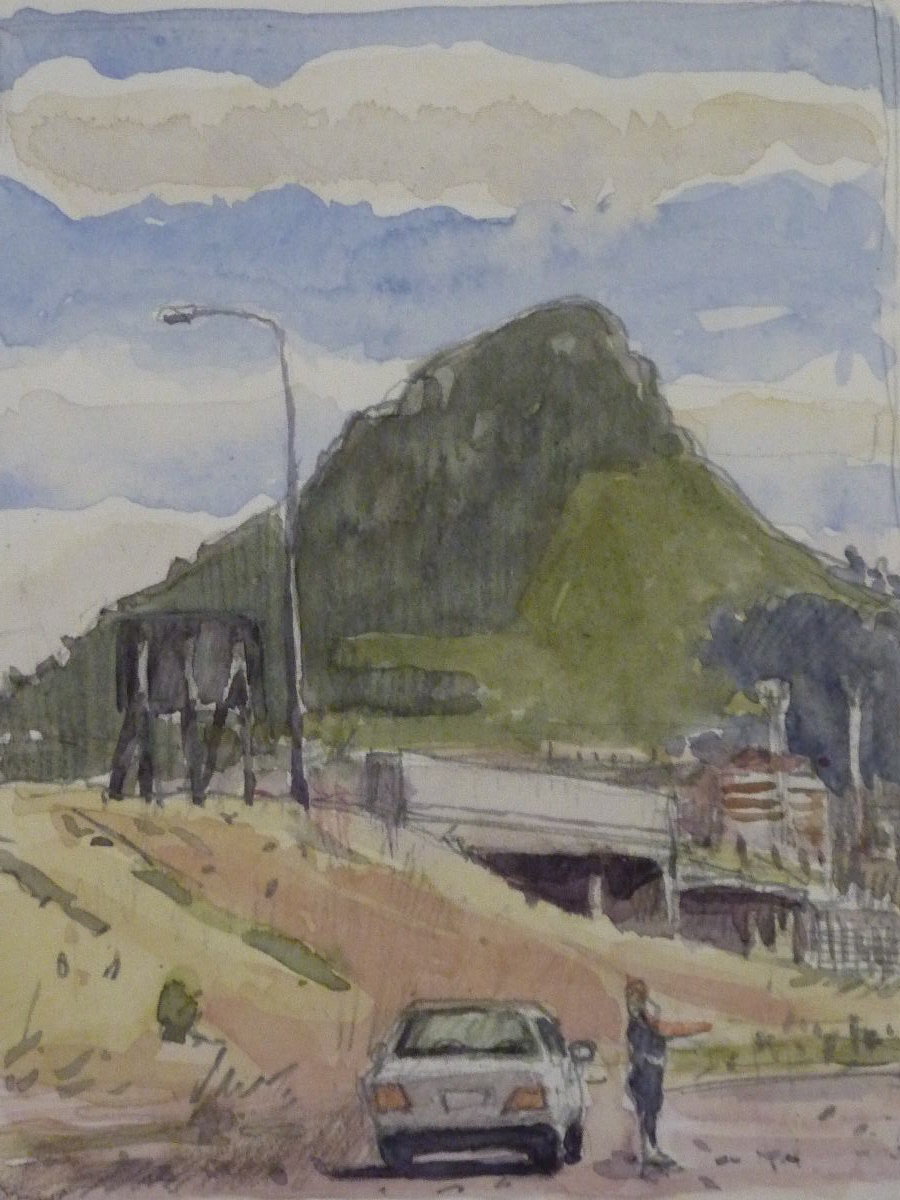
You take it slowly on a dirt road, and that makes you look at where you are. I’m looking at some pretty big mountains, feeling suitably insignificant. I’m sure I’ll find the site near the bottom of the pass, but I don’t. I do a watercolour and carry on up. There’s nothing that looks vaguely like the place I’m looking for, but the Pass is stunning, something new around every corner. Quite near the top I have something to eat and do another watercolour, then head to the top. There’s a fierce wind , so I stay in the car and do a third little watercolour sketch.

view from 'die top'

OK. I’ve got a page of watercolours but no idea where the site is. Perhaps he made it up?

Forgive, dear Reader, my lack of attention. There’s been a distraction, you understand. Yes, soccer. Watching the games, I find myself reaching for the mute button on the remote a lot. Mainly when the commentary gets irritating. And also that monotonous vuvuzela racket. But it was not always thus.

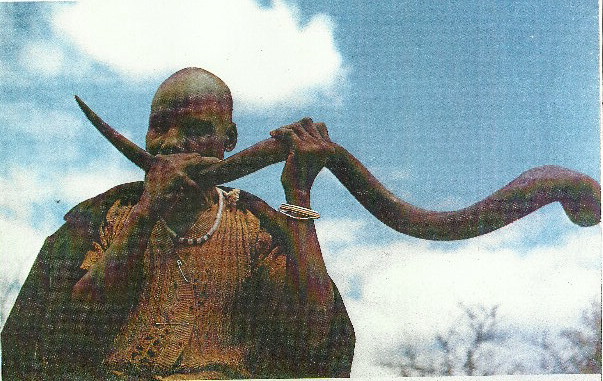
the traditional horn

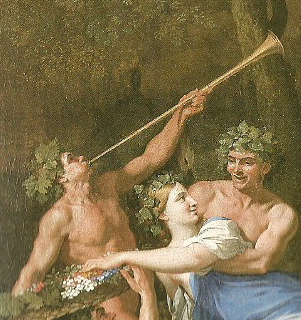
The kudu horn has a more solemn intonation. And fewer decibels. The man who gave us the vuvuzela is a 37 year Capetonian called Neil van Schalkwyk, who has sold 800 000 of them, including an order for 40 000 from Sainsbury’s in London. He now also makes a slightly less noisy version, but will the cheap Chinese vuvus be so too? Sadly, Van Schalkwyk was unable to patent his invention. After all, the horn has been around for a while:

Nicolas Poussin 'The triumph of Pan' 1635

I actually like the vuvuzela. It stands for African spontaneity and ebullience. But Mondli Makhanya‘s point – that we’ve replaced songs like Shosholoza with a plastic cacophony- is true. Go to a game with 50 000 of those at full blast? No thanks, I’ll be watching at home. Sticking close to the mute button.

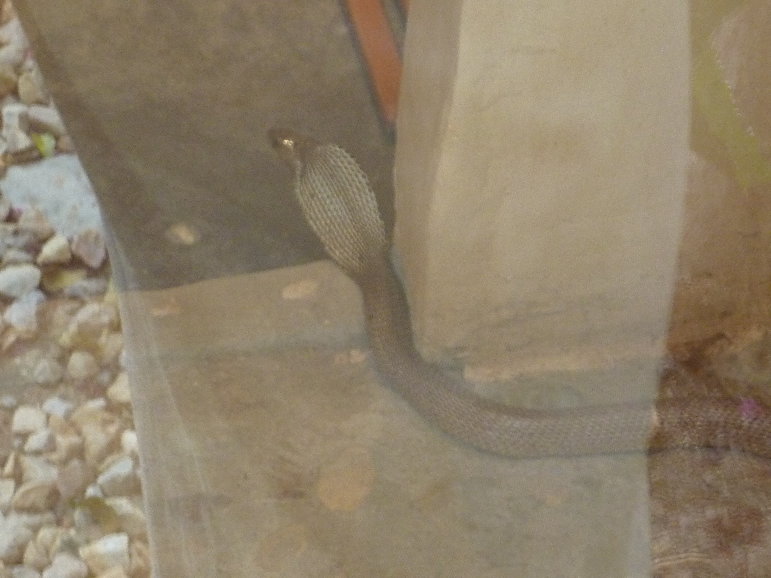
I’m padding through to the kitchen to make my morning tea and under the kitchen table there’s a heaving and a slithering thing heading away from me towards the bathroom door where it thrashes for a bit before finding its way underneath. I calmly seal the door before noticing I’m sweating. Then I go looking for the town’s snake catcher. A guy called Gerhard offers to shoot it. I still don’t know exactly what type of snake this is, so I head to my painter friend Diane McLean who tells me what to look for. And then I get a good look at it through the bathroom window.

gooie more suid afrika!

After quite a few calls and a flurry of sms to Hermann (there’s a cobra in the bathroom! Qrtrfgtr! Sit tight! Don’t let those fuckers kill that snake!) I get through to the Oudtshoorn Fire Department and half an hour later the okes arrive and deftly remove the snake: “Jy moet kalm wees. As jy woel, dan begin die slang ook woel .” They released it on the way back.

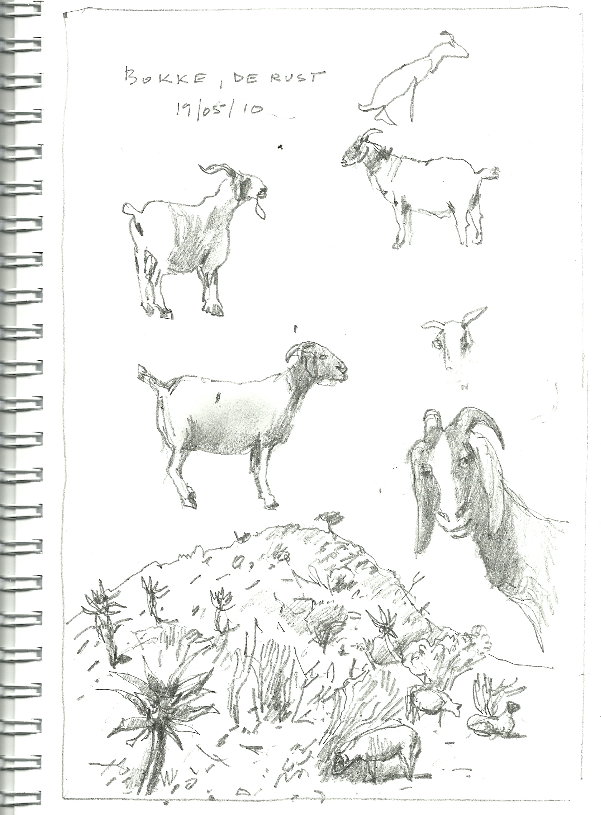
In the afternoon instead of going to the Poort I head out on a farm road and find myself in a kraal with some slightly haughty goats.

what's HE doing here?

Snakes. Goats. What the hell am I doing here? Get me to a shopping mall!

From De Rust you cross Spookdrif, Skansdrif, Damdrif, Boesmansdrif, Skelmkloofdrif, Aalwyndrif, Nooiensboomdrif and there it is, Dubbele Drif se draai:

jh pierneef. Meiringspoort

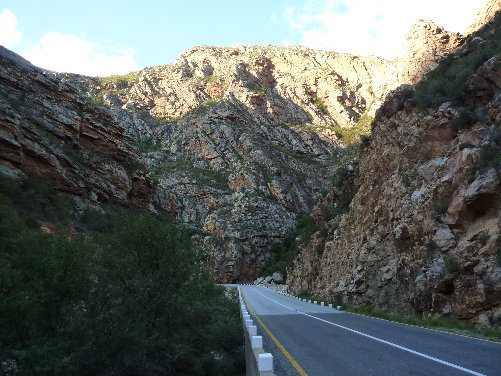
Following the curve of the road, this is the right place. It seems as if the river’s on the right, but if you look closely its running onto the road from the left. The river now runs under the road. And that large boulder is indeed there. Because of the new bridge, I can’t get as close as he was, so the cliffs seem less towering. The light coming in from the east tells me he was here early on a summer morning. At this time of year it only gets a touch of late afternoon light.

Dubbele d se draai, 2010

I’m glad that the decision about what to paint in the Poort has already been made for me, because there’s a bewildering majesty to this place and I wouldn’t know where to start. But that thing I said about the silence isn’t strictly true. There are quite a few big trucks winding through here. And some of them like to hoot at the weird oke in the hat painting next to the road, which makes me jump.

The famille Niehbuhr takes their leave and I’m alone in the old karoo house. If you go to the front stoep in the morning, you’re likely to find its lunchtime before you know it.

Hermann se plek

I head straight for the Poort. The road follows the river beneath giant crumpled cliffs. In summer the heat will knock you down, but in early winter there’s a clarity and stillness to this place that astounds me.

cowboy country?

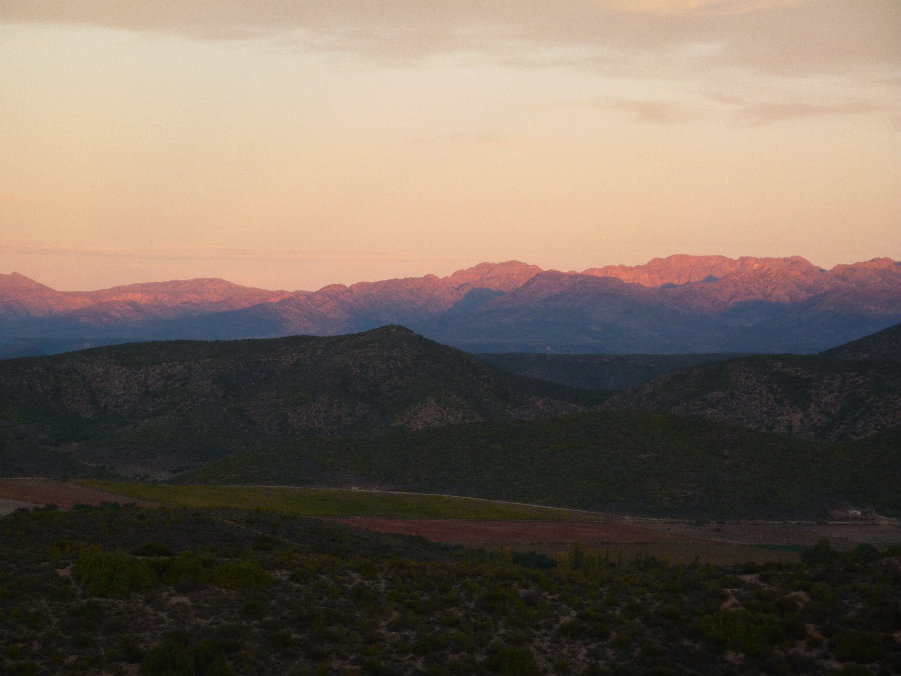
Way down there in Hermanus the rain and cold is coming in and on the R62 it’s light and warm and cloudless and I can feel my winter coastal depression lifting as the road winds ahead.

is daaie die swart of blouberge?

In De Rust in the late afternoon there’s a donkey cart clattering down the main road. A tiny khoisan woman bearing a large pumpkin comes down the hill and tries to sell it to me. She’s lurching a bit, not only from the weight of the pumpkin. There’s a bloke hovering in the background. The pumpkin is the best thing that’s happened for some time, and its probably going to end badly. Slightly unsettled by this reminder of the abject state of our first people, I meet Hermann’s son Thomas and his American grandparents. They like the Klein Karoo, are puzzled by the ‘German speaking brown people’, and have an unnecessary fear of encountering a Cape Cobra.

rustic nirvana

(Double clicking on any photograph gets you an enlarged version)

Coasting up the N2 near Riviersonderend

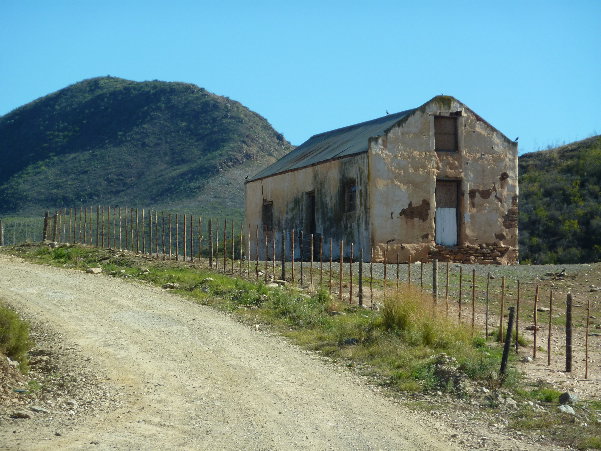
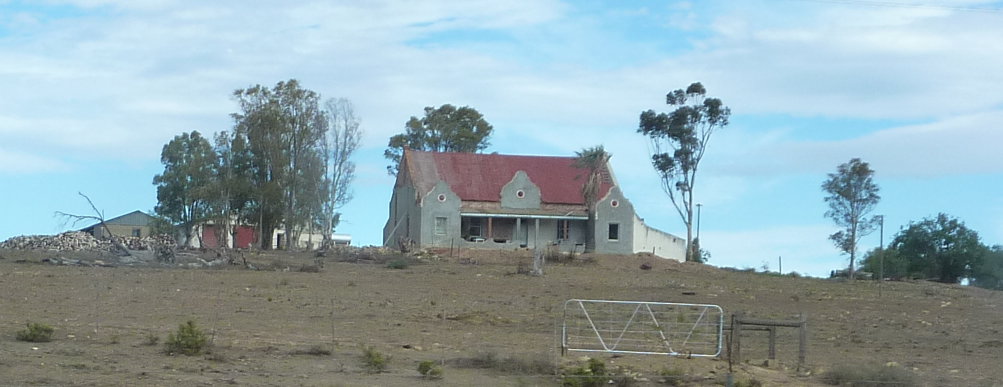
semi abandoned farmhouse

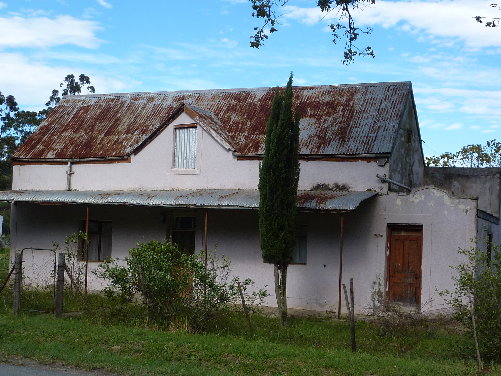
SA painter Walter Meyer put a lot of chickens in the pot painting this kind of thing.  I can’t help thinking about stopping off to do a quick watercolour. But then I start thinking about the great American watercolourist Andrew Wyeth and his meticulous and chilling images of the deserted heartland (see Christina’s World 1948). Nah. Imagine having the ghost of Wyeth leering over your shoulder while you work. I’m having enough trouble dealing with Henk Pierneef, and he was a genial kind of a guy.

huisie in Suurbraak

Over the mountains to De Rust tomorrow to pay my respects to famille Niebuhr. Then into nearby Meiringspoort, watercolours at the ready.


the C19th digicam


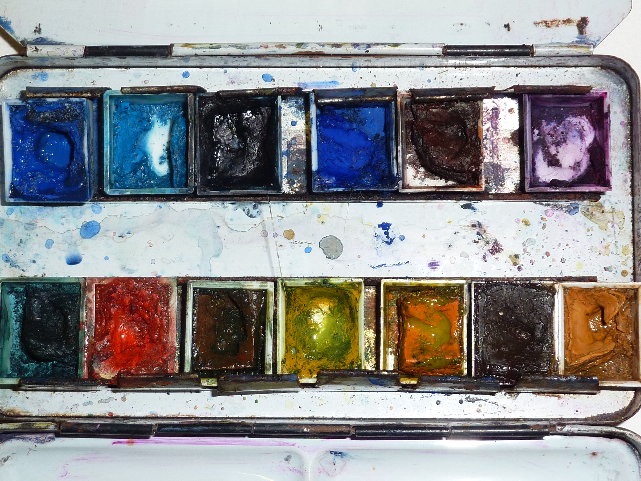
Don’t worry, I’ve got another block of Quinacridone Red (top right).

If I find an internet cafe in De Rust, dear Reader, I shall make a posting or two. Otherwise see you in about twelve days time….

I leave you in the good hands of this fellow traveler


Croc man and curio. gouache on paper.


With our blogger’s computer ostensibly fixed, some pics of the recce to Stellenbosch. What I was looking for:


Stellenbosch station panel


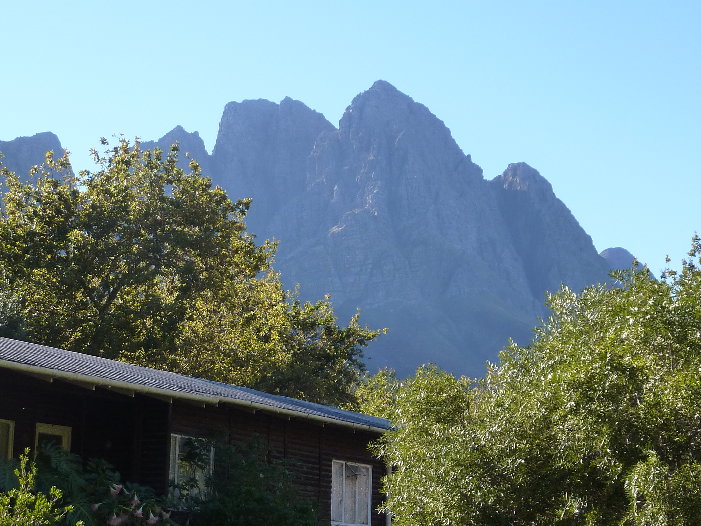
Driving into the town from the south the mountains were curiously shy, even absent. I ended up in the dorp itself, dodging Sunday morning churchgoers and Dylan Lewis cheetahs. Eventually I sniffed out the yellow leafed road to Jonkershoek. That’s where the mountain is:


the purple mountain


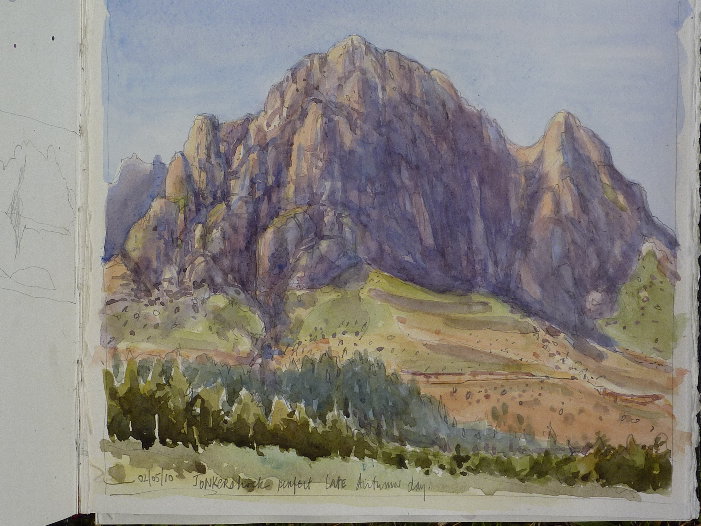
I kept on up the valley and at the end there were many cyclists and a nature reserve. I was too close to the mountain by now, but did this watercolour anyway. Its not very good but hell it was lekker up there in the Autumn sunlight.


retro - moderno - H20


Forgive dear reader your blogger’s absence. I took off to Stellenbosch to see if maybe I could find Harry Kalmer there and bliksem him after those nasty things he said about my paintings but no such luck all I saw was a whole lot of Dylan Lewis sculptures which didn’t really help so I went up the road to Jonkershoek and did a watercolour of Pierneef’s mountain in the late Autumn sun (and I would show it to you if my computer was working properly…)

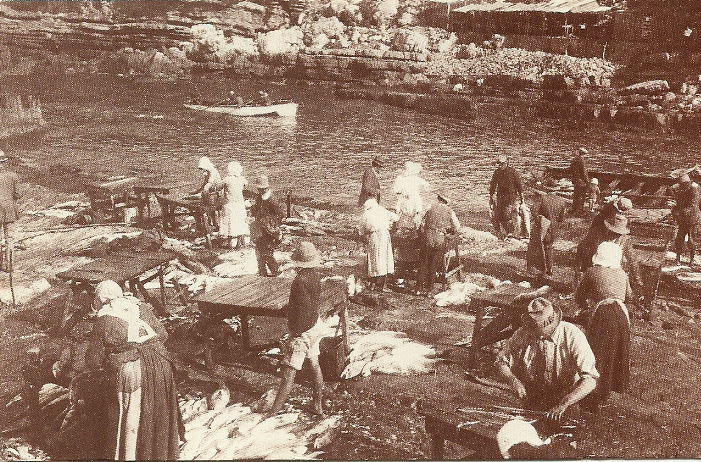
Pierneef’s depopulated harbour in the 1920s:


Gutting those fish.


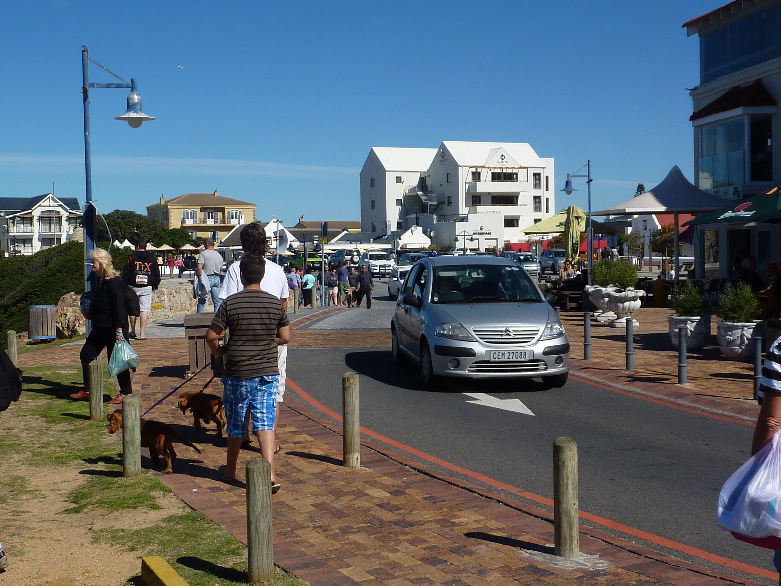
A regular hive of activity. OK. So maybe he did the drawing on a Sunday morning when everyone was in church. Today the action is above the harbour, the Euro and $ the catch. (note trained tracker dogs sniffing for Euro’s)


Op soek na die Euro


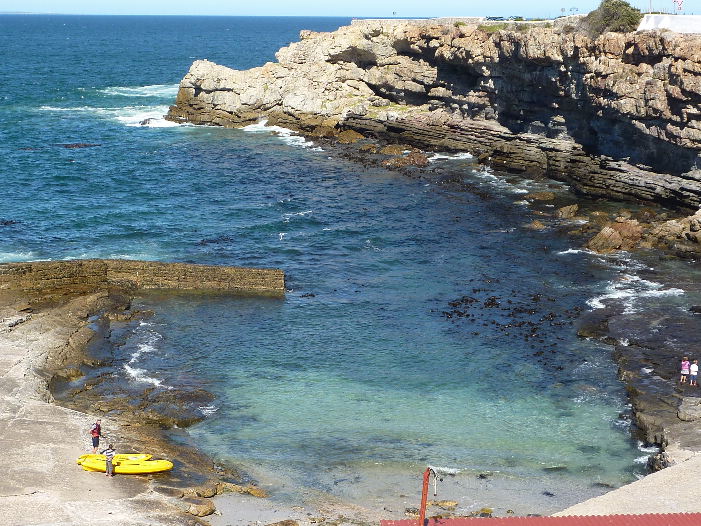
The harbour from above: Pierneef took his view sitting  near the milkwood on the right. The rocky overhang below that is also a great place to draw from. My friend Harry Kalmer didn’t like the soporific watercolours I did down there – he said I needed to get back to Joburg!


overlooking the harbour


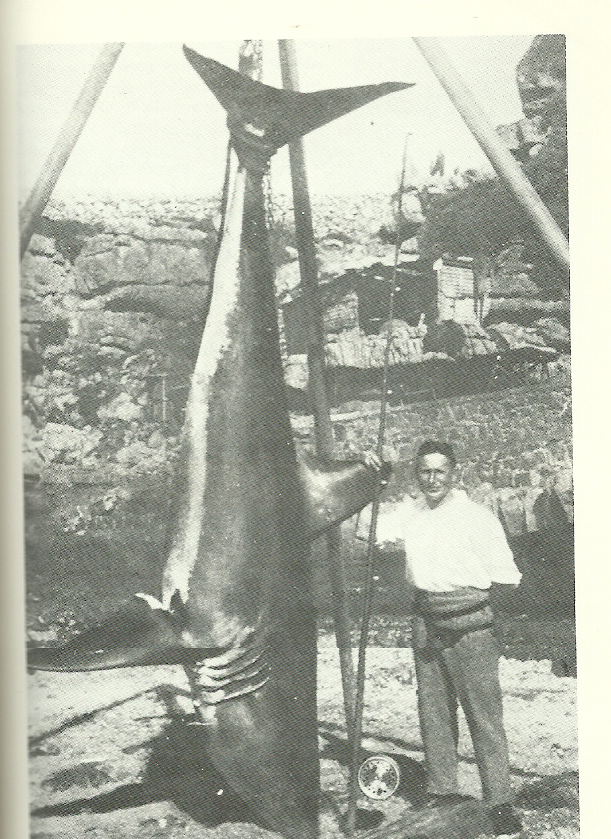
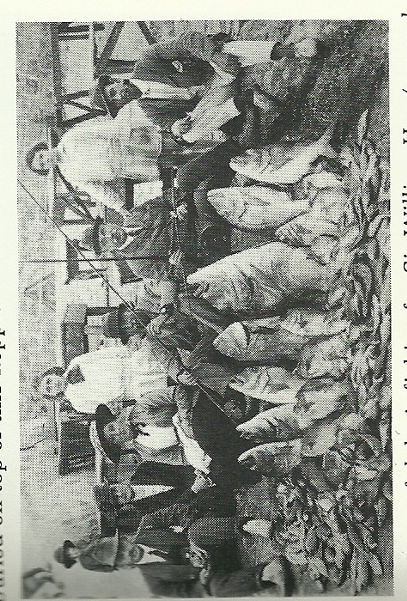
Pierneef may have chosen the old harbour site to please his patron, but by 1930, Hermanus was already a famous fishing paradise. This was largely due to the exploits of one Bill Selkirk, who, after a five and half hour battle from the rocks at Gearing’s Point, landed a 987kg shark:
 

Selkirk and shark


The London Illustrated News devoted a double page spread to this in 1928. The De Wets Huis Photo Museum has many other pics of fishermen and their “trophies”. But by today’s standards these examples of manly virtue may look like accomplices to a crime: We no longer subscribe to the idea of killing animals as “sport.” And there are hardly any fish to be had.


Giant Ray


Giant Ray and Boy . Watercolour 22 x 17cm .2009

Pierneef started work on the Station Panels in 1929. The General Manager of the SA Railways and Harbours was Sir William Hoy. For years he spent his annual vacation at the Marine Hotel in Hermanus, where he took the good air and fished.


Fishing with Sir and Lady Hoy


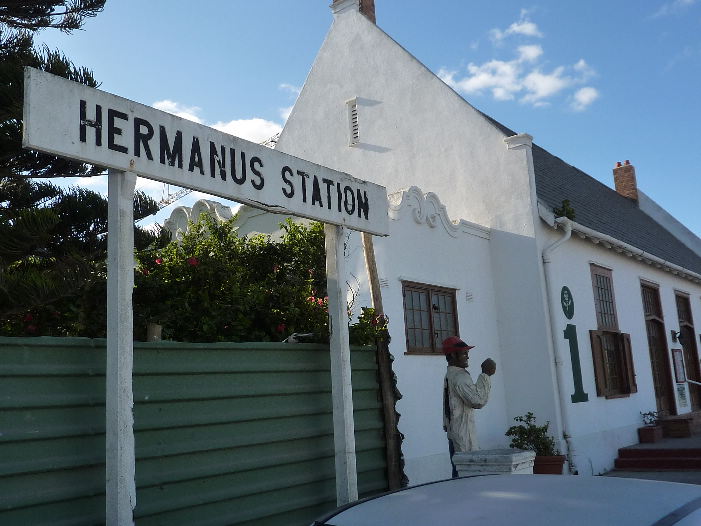
The Old Harbour was under the jurisdiction of the SAR&H, and this could explain why Pierneef chose to include it as one of the Panels. Sir William may have enjoyed the artistic rendering of  his retirement town. (Did JHP stay with him when he was in Hermanus? Did they share a bottle of port?) But he may not have relished the prospect of more tourists: He vetoed a railway line from Caledon to Hermanus. The station had already been built in 1912.


The station that never saw a train


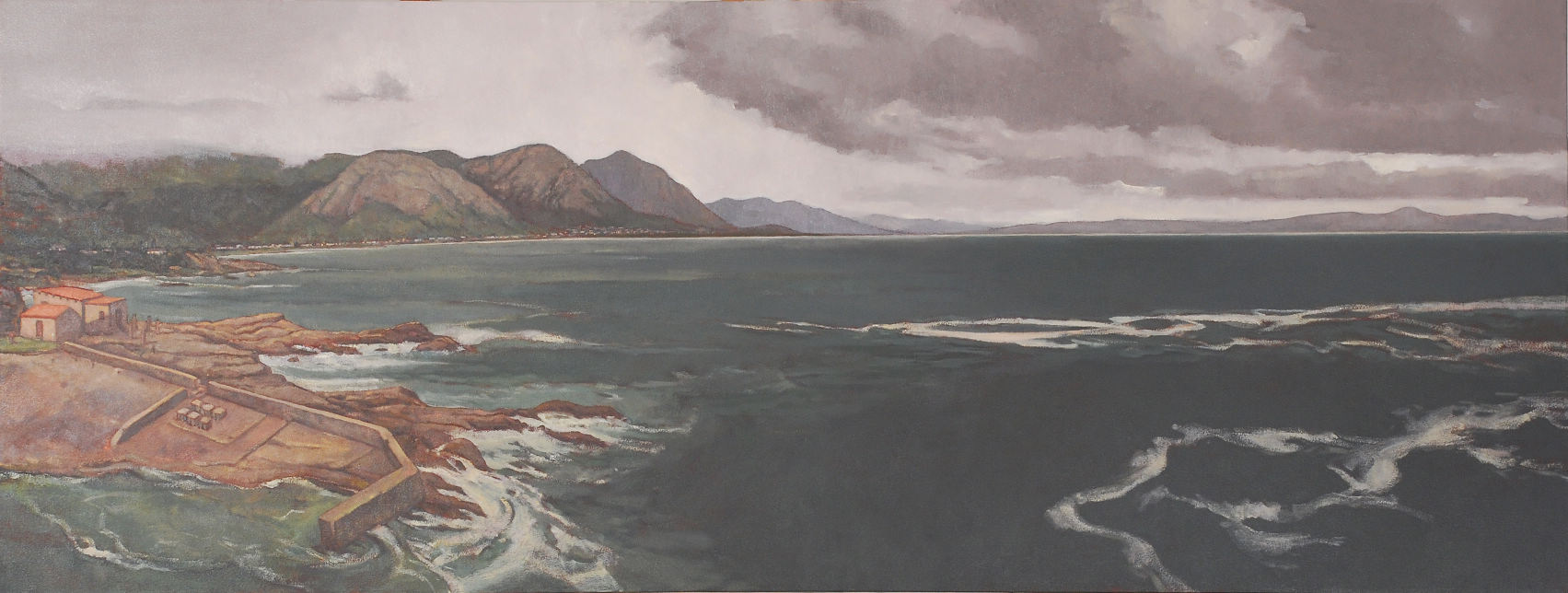
Not Valentines day, but Nineteenth Century Romanticism. The Romantic painters responded to the industrial age by looking for the sublime in Nature, a quest that was both aesthetic and spiritual. And even well into the C19th, when the Impressionists were drenching themselves in sunlight, the gloomy Northern Romantic tradition continued. (It’s been argued that Pierneef belongs to this current in European painting.)

I chose to show the harbour buildings overwhelmed by the magnitude of an Atlantic storm: A very Romantic idea.


Old Harbour, Hermanus.


Oil on canvas.60cm x 170cm.2009

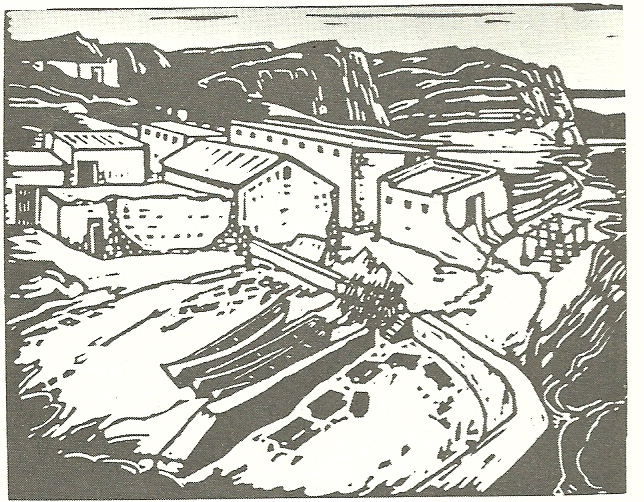
Pierneef’s woodcut of the Hermanus old harbour. His graphic output – woodcuts and linocuts – was huge, and all of it of very high quality.


old harbour, woodcut. c1931


See my post Down South (below) for a look at his painting of the same. It still looks like this – except for the boats which were washed away in a storm in 2008. And even though the camera tells us the buildings are much smaller, this is far more ‘realistic’. Perhaps it reinforces what we choose to remember? Or reassures us that we are imposing ourselves on Nature?

What emerged out of that was the recolouration I’d been hoping for (you don’t quite know what it is, but you recognise it when you see it.) I also lost some lekker paintings within paintings


lost Picasso sculpture


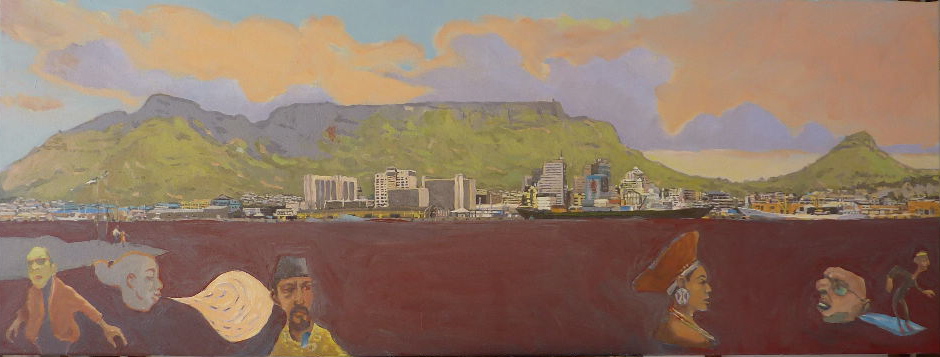
Then there was the small matter of The Sea, the dreaded sea. After numerous false starts I remembered Anton Chapman‘s advice about putting down a base of deep red. He has painted a lot of sea and knows his stuff. A layer of Venetian Red and some editing decisions later:


Red Sea


And after quite a bit more tweaking:


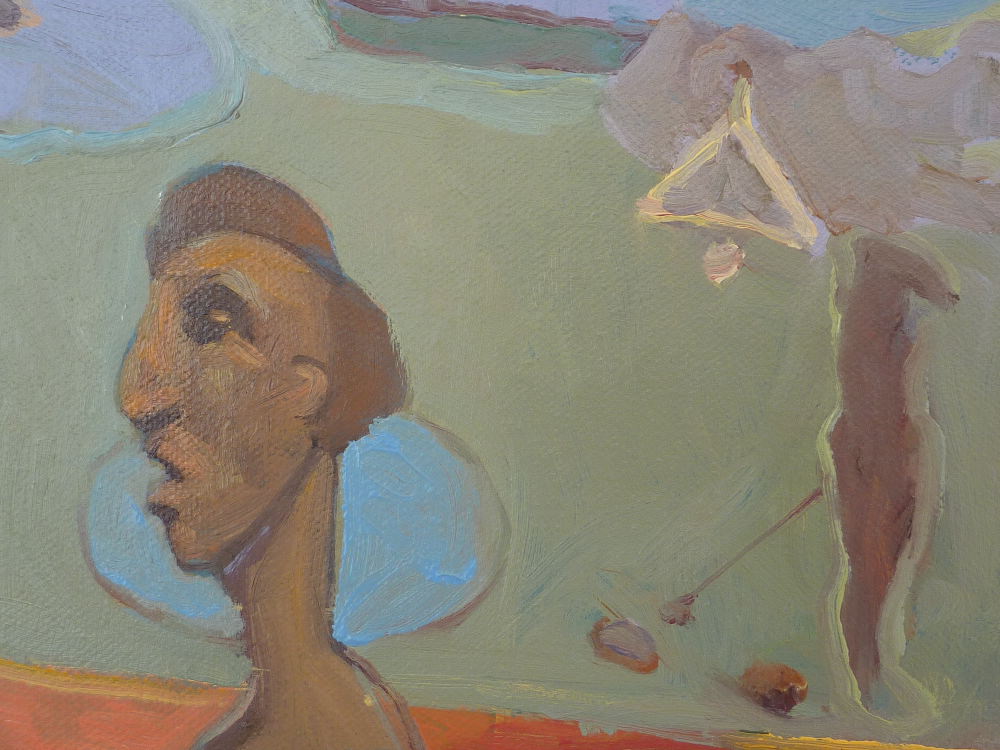
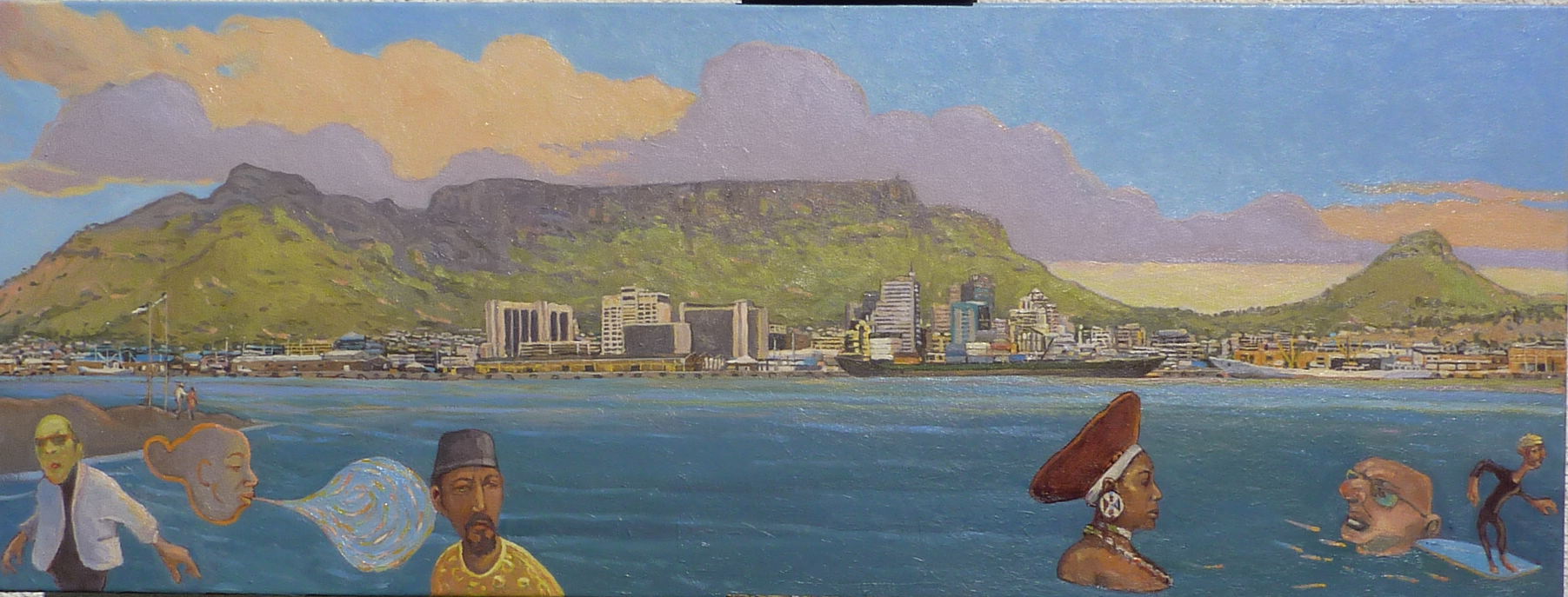
Cape Town Personae


The beast is laid to rest at last.

OK hopefully now these okes will not disappear into hyperspace when I press the ‘Post’ button …


really a nice bloke at heart


me too


I liked these guys

and now they at least

have a virtual

if not a paint life!


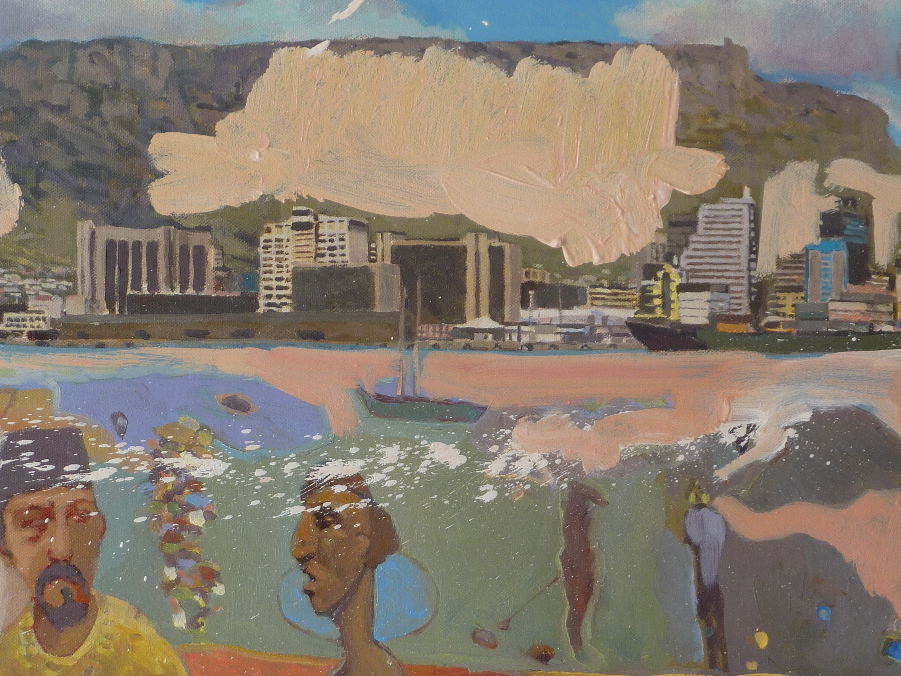
Painterly discontent.  Unhappiness with the colouration as well as an inability to resolve the compositional challenges leads our humble painter over the edge!

I don’t know what the hell happened to that last post! It’s Sunday night and I’m getting irritated, so here’s a quick look anyway at the full painting, at the point where it gets really interesting.


the long shot


Well here they are – and some got away from the painting and now only have a virtual life!


aging groover quits town 2 This is what's known as becoming a victim of your imagination. Suddenly the painting could go in any direction (as well as downhill): the long shot.


I finally figured that JHP was down by the docks – at something called Berth A. After wheedling my way past security, I felt sure this was the site: a view across the water of Lion’s Head with some industrial buildings in the foreground. Back in the studio I started rendering the panorama in a fairly loose but literal kind of way, laying in the details happily unaware that I was about to ambushed by a whole range of dubious characters….


Lion's Head (detail)


Dear Reader! Since our readership has dwindled! we’ve decided! to make this blog! a bit more like the Daily Sun!

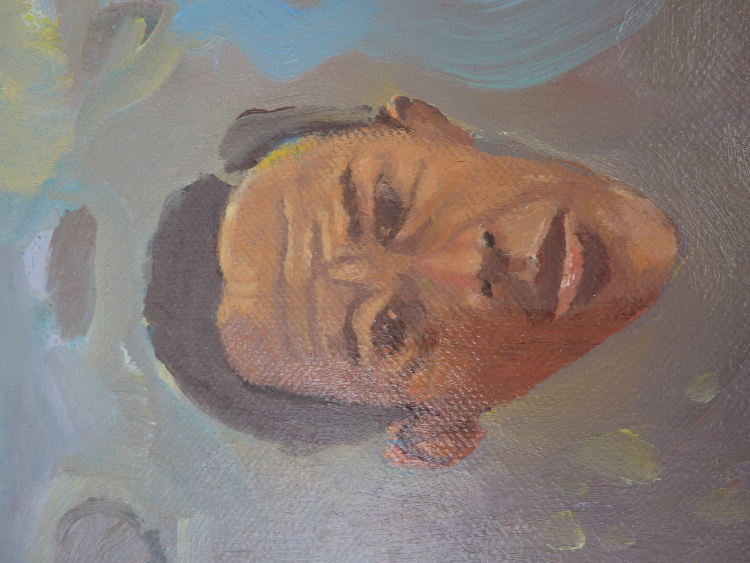
or is it a self portrait gnashing teeth ?


Two little views of the Leeu se Kop, the one in the Bo Kaap in February, sweating in the afternoon sun. The other done in March on a nondescript Saturday afternoon. Edward Hopper – a superb watercolourist – was fond of taking a watercolour from behind the frame of the windscreen.

Since our man often combined different views in a single image, (like the exaggerated buildings in the Hermanus panel) I figured in the Lion’s Head panel he’d done the same. So I started close to it and worked my way backwards to the water and the Postmodern malaise down by the docks….


Lion's Head (with a Damien Hirst dot)


scratching around...


We took the Jeep over the mountains to Franschoek to check out the Solms Delta Oesfees, where we heard some really good local music. I wanted to see my chinas in the Radio Kalahari Orkes, who I haven’t heard for a long time. They drove down from Jo’burg in a 1973 Kombi and played a blistering hot set that was an explosion of joy. The biggest figure in their musical heritage is a guy called Dawie de Lange, a 1930’s rebel boeremusikant who was banned from the airwaves by the Afrikaner establishment. I wonder if Pierneef ever heard him?


Die Orkes skop gat!


Hermanus – my home town for the last two years – is the southernmost site.

Two things strike me about about this panel: He made the buildings look a lot larger than they are, and the total absence of the human figure. In those days the harbour was a hive of fishing activity. The photographic museum nearby has great pics from those days of trophy fishermen alongside their monsters from the deep. Now, sadly, you’d be hard pressed to find fish in Walker Bay. Except of course for whales. Which aren’t supposed to be fish….


Hermanus


Cape summer hues:  Those what-colour-is-that grey greens of the Cape mountains in summer. And the ubiquitous mauve. Pierneef got those mountains in the background dead right.

For a few years now I’ve been on a mission to find and document the original sites of Pierneef’s station Panels. The paintings, done in the early 1930’s originally hung in the Joburg Station but are now housed in the Pierneef Museum in Graaf Reinet. There are 28 landscapes. Pierneef was in his early 40’s when he did them and they represent a highpoint in his career – the point where subject matter, content and style coalesce into something really strong. They secured his place as SA’s leading painter and ensured a widespread popularity.

Today we tend still to look at them and sense that they convey the essence of the landscape. By revisiting the sites, I’m trying to find out what’s left of them – how much remains after 80 years of development? Does Pierneef’s sense of those places still exist? Are they really as grand as he made them or was he a hopeless Romantic?

HOW TO DO IT?

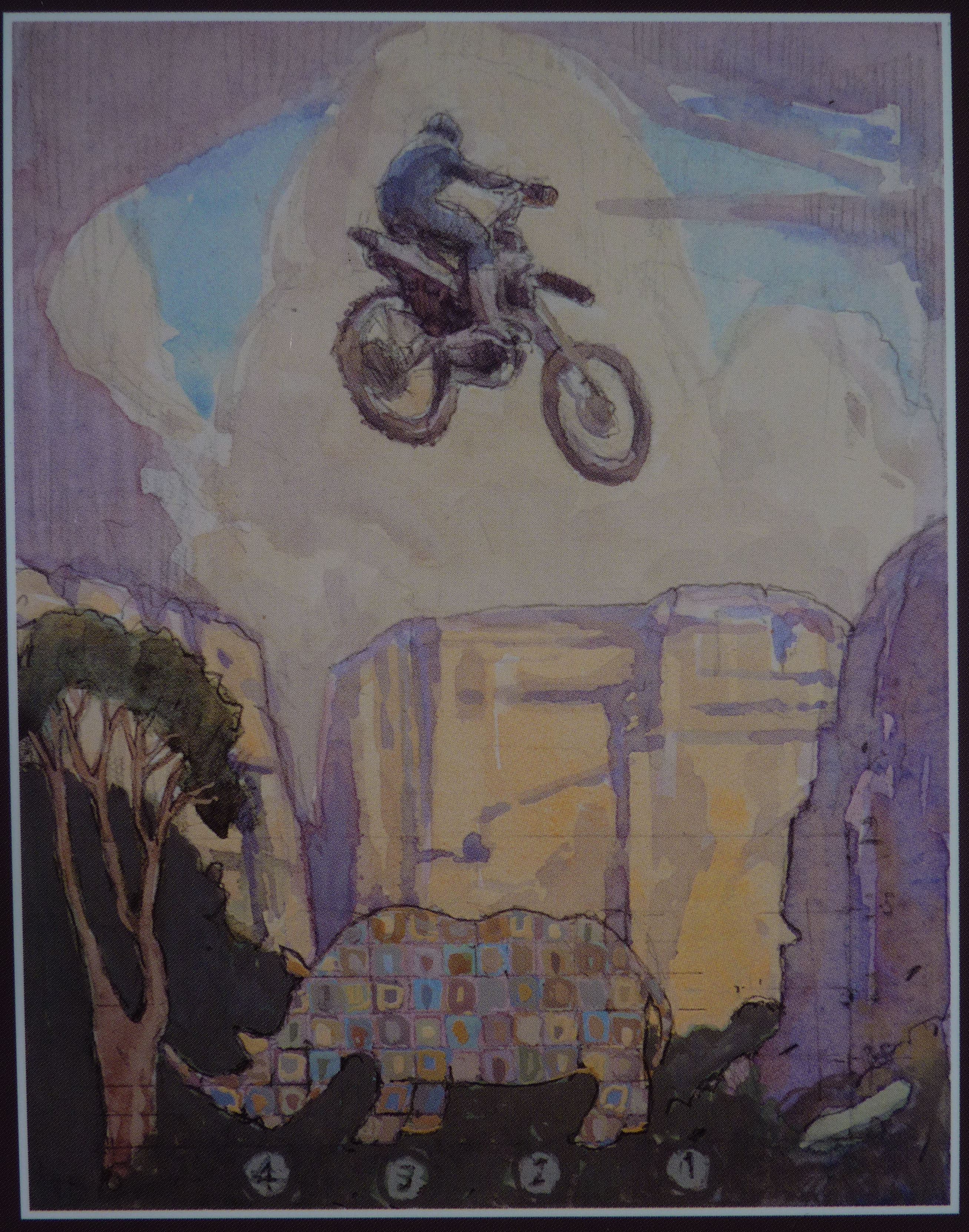
It took me a while to figure out that I would do work that relates to the site itself and then work that relates to Pierneef’s original paintings. When I get to a site, I do watercolours and drawings as an initial response. Later in the studio I work up paintings from photographs. But there’s also a set of works that responds to Pierneef’s paintings. These usually take the form of a modified Pierneef – the original injected with some image that seems appropriate to the place.

RUSTENBURG KLOOF

The first place I went to, about 2 hours NW of Jo’burg. Easy enough to find – it’s on the map. It’s a ‘plesieroord’ with well tended lawns and bungalows. The cliff face stares right out at you and looking at Pierneef’s original painting, it was easy to figure out exactly where he was when he did the initial studies. (He did hundreds of preparatory drawings.)

This is Pierneef’s original Rustenburg Kloof Panel:


Rustenburg Kloof. Oil on Canvas. 141cmx126cm


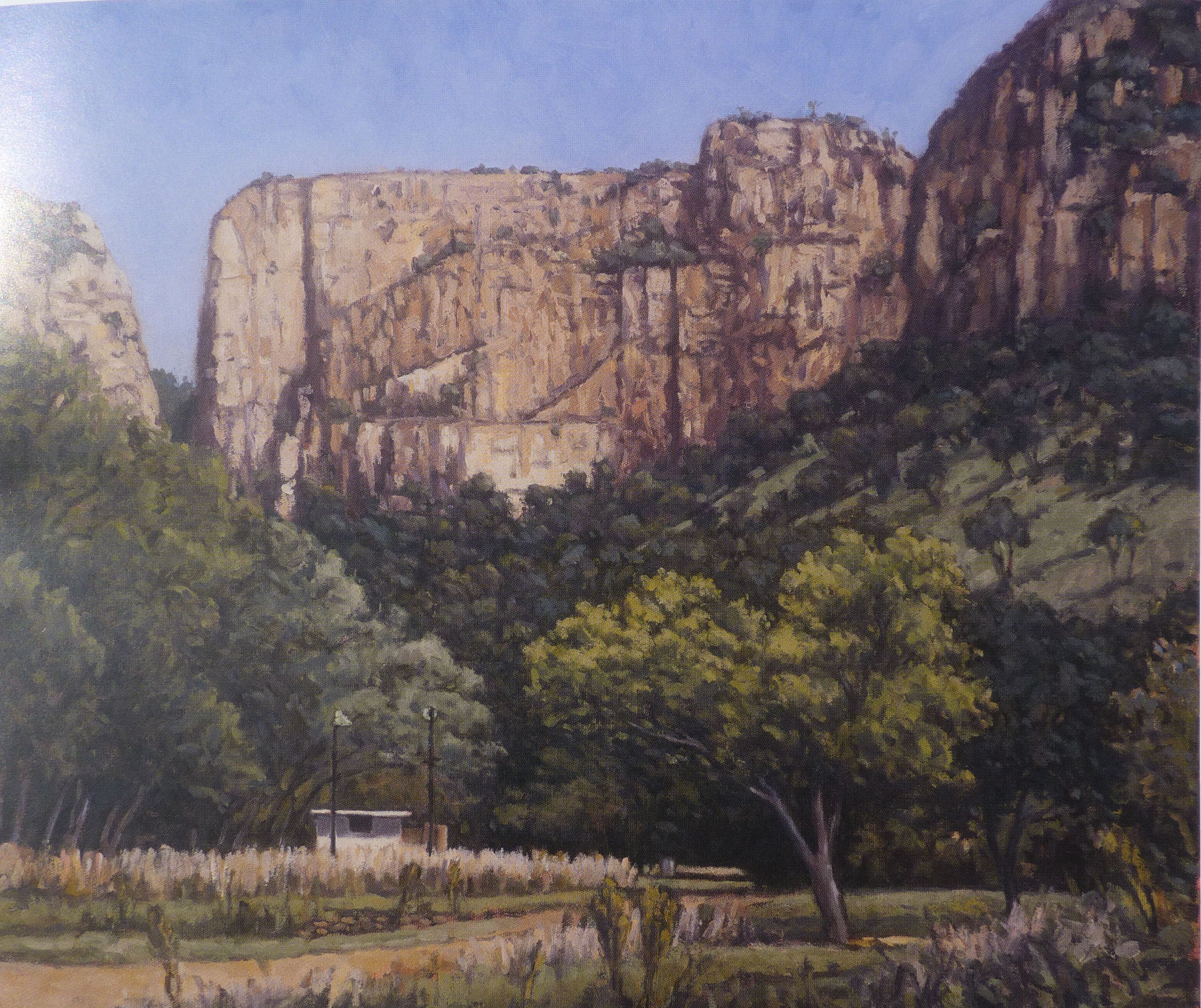
This is my oil painting of the site:


Rustenburg Kloof. Oil on canvas, 50 x 60 cm.


And this is the modified version:


Biker 3, watercolour 17.5 x 13.5 cm


J H Pierneef’s Station Panels are cornerstones of South African landscape painting. They were placed in the old Johannesburg Station as adverts to travel the country.

But did these alluring places ever really exist? And how have they changed?

Taking up the invitation to travel 80 years later, Carl Becker set off to find out.

Enter your email to receive notification of new posts.

Join 805 other subscribers

Contact

carlbecker.art@gmail.com

Categories

Archives