You are currently browsing the category archive for the ‘Uncategorized’ category.

I’ve had the brush in hand since early January,veering all over the place. The recently visited KZN Pierneef sites demand attention. Also, there’s the series of small portraits of writers and artists. I’m doodling with the pencil, digging up old photographs and reading, skipping around. I do drawings of Jan Rabie, the Sestiger with the sonbrille. I also delve into Nigel Penn’s “The Forgotten Frontier.” Christopher Hope’s “My mother’s Lovers” triggers a lot of memories of my home town. I’m thinking about big summer clouds and lush, alien gardens surrounded by surveillance cameras. I start work on two canvases, with Carol Lee’s “Vista” show in mind. Quite quickly, I lay down the bones for two related works: Green and Blue vistas. They both come out of recent travels. If ever there was a vista, the Drakensberg Amphitheatre is it. Appropriately, the work has Pierneefian overtones, but the real subject is the human “landscape” surrounding the Amphitheatre.
I start work on the blue vista – a blue version of the the Joburg skyline. I don’t know why, its just the idea of a blue city (and all that it implies). I use a photo of the city taken on the M2, the western side. I do small pencil drawings. The painting won’t look like the pencil drawing – that’s just a trick to get me started. I map out a grid, which helps me transfer the detail of the photo to the canvas, but I don’t bother drawing in the outlines. I go straight in with a flat brush, using a lot of cobalt blue, some burnt sienna and titanium white, correcting as I go.
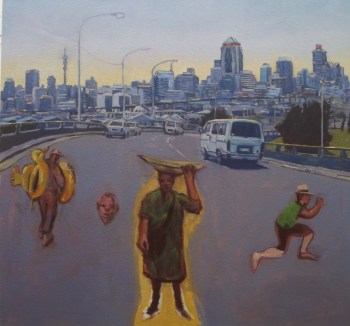
the first draft
I’m taking factual information – the backdrop of the city – and I’m adding imaginative, narrative elements. I’ve started with the idea of a central female figure, but the pink face, the duck man and the photographer have cropped up as I went along, sparking new associations and meanings. I work some more details into the background and after a day or two I realize the pink face has to go. Then the photographer. Then I rework the figure on the left, as well as completely re-doing the central figure. A touch of cerulean blue in the background, a bit of subdued red, a few tonal changes, and there, its done. The rural woman has come to town. The place of glamour and dirt, of re-invention and blue moments. The man trudges to town from China City adorned with gaudy plastic ducks. He sells them on the other side of town, where they float briefly in suburban swimming pools. He sees the girl. Perhaps if he sells enough he might buy some new clothes and she would notice him? But she has other things in mind. Is that the story? Maybe.

“This world ain’t all sunshine and rainbows, son. This world is a very mean and nasty place.”
-Rocky Balboa-
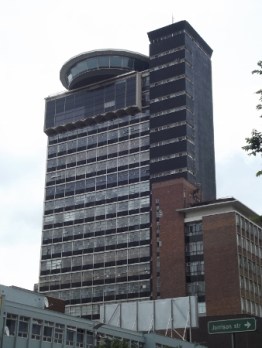
70s modernism. What goes around….
Braamfontein was once the epitome of Joburg modernity: a dense cluster of high rise offices, all in the service of the 9 to 5 working week. Abustle during the days, the streets were empty at night, save for the odd drunken student stumbling back from the Devonshire Tavern. There was the folk club where I saw Colin Shamley, circa 1975. Above the entrance someone had posted an ironic sign saying “non blacks only.” I worked in a Braamfontein office in the early 80s, but not in a nine to five way. We were trying to get rid of the mean bastards who had put the petty apartheid signs up in the first place. In the 1990s, as the Joburg CBD went down the toilet, Braamfontein followed.
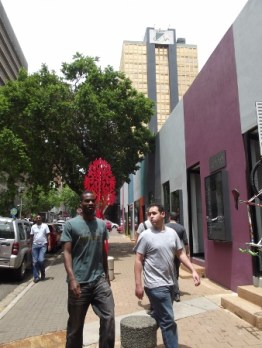
Large TO LET signs cluttered the skyline, and things were looking bad. Then they built the Mandela Bridge, and a few brave souls ventured back. I took a peek into Braamies in early December and was astonished to find a whole new world of trendiness had opened up, just like that. On a Saturday afternoon in Juta Street cool young people shopped and hung out around the street sculptures. There was a bicycle shop, several art galleries, designer clothing outlets and a camera shop.( Film, not digital.) In the Michael Stevenson gallery on the corner, Jane Alexander was exhibiting.
In the 80s, when Jane Alexander was at Wits, I used to see her walking through Braamfontein. She wore black, was always on her own, and looked intense. It made sense then that the “Butcher Boys,”one of the most potent artworks of the 80s, had come out of that person. And so here was Jane, back in Braamfontein. There were two pieces on show. In the ironically titled “Survey: Cape of Good Hope,” you are drawn into a series of very good documentary photographs of the dreary, dangerous underbelly of the Cape. But as the images come onto the screen, you realize that among the gulls circling over rubbish dumps, Alexander has randomly inserted her own creatures. This immediately subverts the realm of the documentary photograph, as well as our expectations of what it should be. These human /animal hybrids seem to belong here, claiming their own trashed-out landscapes.
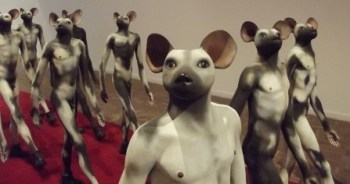
A second room in the gallery is occupied by a work called “Infantry with Beast”: 27 marching, regimented creatures, eyes right. They have the surrealist trick of defying our habitual cognitive folders. What are they? Looking into those eyes, we meet a very archaic tradition that goes back to the primitive therianthropes of cave art. Walt Disney was a great manipulator of this imaginative vein of course, but where Walt gave us sunshine and rainbows, Alexander gives us the mean and nasty place. An Alexander sculpture sold on auction recently for a record R5. 5 million. The market got it right this time: Alexander’s work deserves to be right at the apex.
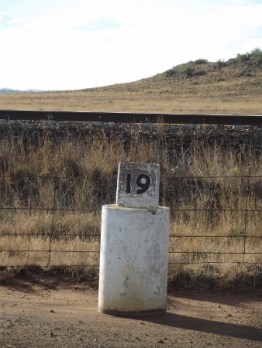
The milestone. That round white concrete thing squatting next to the road. A remnant of a bygone era, the pre-signpost era, the era of coach and rider. If the milestone does have a function, hardly anyone these days knows what it is. The numbers on it never seem to tally. Joburg writer Ivan Vladislavic, on his daily walks through town, discovers many of these mysterious remnants. They speak to us of hidden histories. A Japanese writer calls this category of thing a “tomason”and obsessively notes the locations of hundreds of them.
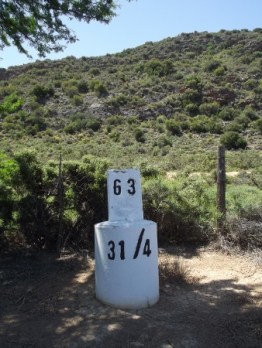
Back in the days when Kobus Kloppers traveled the dusty roads of the interior, he did some fine drawings of milestones. Perhaps with Kobus’ drawings in mind, I found myself staring fondly at the milestone above, on the R62 near Barrydale. Sometimes we notice things because artists paint them. A feedback loop of attention is put in place. New vistas open up, and commonplace things are suddenly elevated. Oscar Wilde claimed that Londoners had never actually seen their fog until Monet painted it swirling over Waterloo bridge. Now that the milestone had me thinking about it, I finally – after 37 years of driving – figured out how it works: Should you see the stone to your left, it tells you how far you are from the last town. One on the right tells you how far away the next town is. The milestone – or kilometer stone – still has a function! Who knows, there may even be a small roads department team out there right now maintaining the milestones, checking that the distances are correct, getting ready to lay down another wash of white paint.
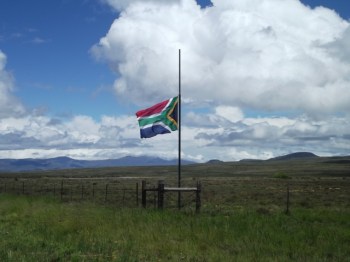
The milestone makes good as a metaphor too. From infancy to senescence the road of life is marked with them. Mandela’s death, of course, was a major symbolic milestone. On the road near Graaff Reinet I picked up a few of the memorial day speeches on the radio. I got verbose dignitaries in adjectival over -reach, trying to grasp the man’s greatness. In effect, they were highlighting the gap between then and now. This half mast flag on a karoo farm was so much more eloquent than all the overblown waffle. Here was proof of Madiba’s reach, a homage to a high road which we may never find our way back to.
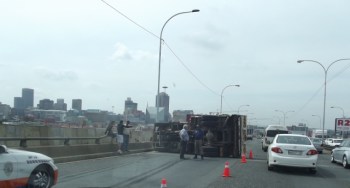
how the hell did they do that?
A long slow road from Hermanus to Joburg, via the Drakensberg, that was my plan. After a week of solitary Pierneef pursuits in the Berg, Joburg was booming, noisy and fast. It was also beautiful and evocative in many ways, and I resolved to get round to some unfinished painterly business concerning my home town. But I didn’t linger. Once I’d navigated my way past this obstacle, the open road beckoned.
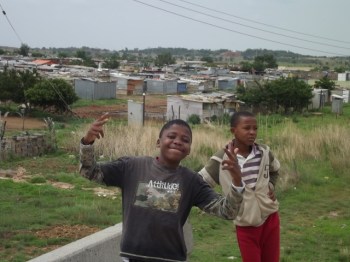
Obscurely, I scrambled up a bridge over the N1 near Sebokeng, where I came across these laaities. The wannabee rapper’s T shirt says “attitude”, but methinks the introverted one has more.
Early December, with the heat rising and big Pierniefian clouds promising rain. Way past Bloemfontein, I took the off ramp to Edenburg, a town one never goes to. You arrive through an avenue of tired bluegums. Fields of shattered glass sparkle in the late afternoon sun. A low budget all year round Christmas decoration, if you will. The petrol attendant was an optimist. ” This is a nice quiet town,” he told me. And indeed it was, in the way patients on life support are. Here were the usual symptoms of the plague afflicting so many of our dorpies: barricaded shops, broken roads, sad okes sitting on the pavement hoping for work.
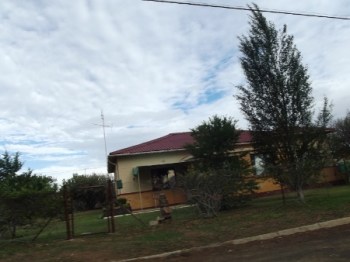
phone Walter Meyer!
The houses here have seen better days, and all they’re good for now is broken- hearted country songs or a Walter Meyer painting. Artists have been painting the karoo dorpie for a long time, but most have recorded its charm. It was Meyer’s stroke of genius to identify an aesthetic that wasn’t charming, but desolate, surreal and alienating, and to register all of that in paint.
I crept out of town towards Trompsburg. Things are slightly better there. Clusters of new buildings rise up in the veld, including a brand new hospital. Clearly, Edenburg is run by crooked bastards, while Trompsburg has vestiges of civic pride. The difference may be just one or two upstanding individuals.

stilte op die vlaktes
There was hardly anyone else on the small road running parallel to the N1. The light was beautiful and I stopped the car and had a look around. Here is this other South Africa, and you don’t have to drive to the Kalahari to find it – it’s just a hop away from the usual overheated routes. There is a big melancholic quiet punctuated by birdcalls and perhaps the odd bellowing cow. It is in this encounter that the idea of landscape painting as a trans-personal, transcendant argument begins.

ready for the mountains?
Since February I’ve been working near Stanford on a smallholding called Wildgarten. I share a studio here with my old comrade Anton Chapman, who is taking a sabbatical from his life in Kiwiland. We work in shifts. Chapman is at his post early in the morning. I breeze in at lunchtime, cook Basmati and lentils, and push through till the evening. A vast oak tree dwarfs the house, and a pleasing expanse of lawn ends in the mauve and grey green Kleinrivier mountains. From the window we see drongos, sugarbirds, and statuesque grey herons. A pair of Egyptian geese have settled in.
Summer comes slowly to the deep south. After a wet winter there is every possible permutation of green you can think of. Here we are, well into our fifties, coming in every day and doing what counts most. Strange, then, that we’re often grumpy, even morose. Our shoulders are knackered, and our eyes aren’t what they used to be. Our heels hurt when we stand at our easels. We have deadlines and our bank balances are a joke. And then there’s the painting.

not another burst of colour!
I’m doing a series of things on SA painters and writers. They’re supposed to be playful and discursive drawings; a relief after the very focused oils I did for the Bloem show. But I can’t get any traction. I seem to have run out of ideas. Soon these drawings will be on display and the world will know I’m a tired old fraud with nothing left to say. The history of art is full of creative struggles, and littered with those defeated by the difficulties: Van Gogh, Mark Rothko, Jackson Pollock, the list goes on. And don’t get me wrong- I don’t like the idea that you should suffer to make art. Not one bit. I want it to be easy. But it seems inevitable that, if you’re going to make something worthwhile, there will be blood. False starts, self doubt and wrong turnings are the order of the day. Here is Bertha Everard, pioneer SA landscapist, in 1917:
” I do wish my picture pleased me more. It is in a most depressing state. Poor technically (I always find that difficult to endure, it touches my pride), unconvincing in line and sickly in colour…..”
A few days later :
” I didn’t work yesterday because I was too hopelessly depressed in every way. The beautiful sunny day failed to rouse me. I worked hard but only succeeded in making matters worse. Looking at it today I cannot find one piece of really able painting…..dreadful.”
Bob Dylan’s statement that behind every beautiful thing there’s been some kind of pain rings true. All the better then to be in this landscape that generously keeps offering new possibilities.

(Quote from Frieda Harmsen, The Women of Bonnefoi)
At the Oliewenhuis there’s a massive Pierneef painting of Rustenburg Kloof. It is bigger than the Station Panels, and going by the technique, probably precedes them. An elaborate gold frame with an undated plaque on it tells us this was a commission from the City of Bloemfontein.
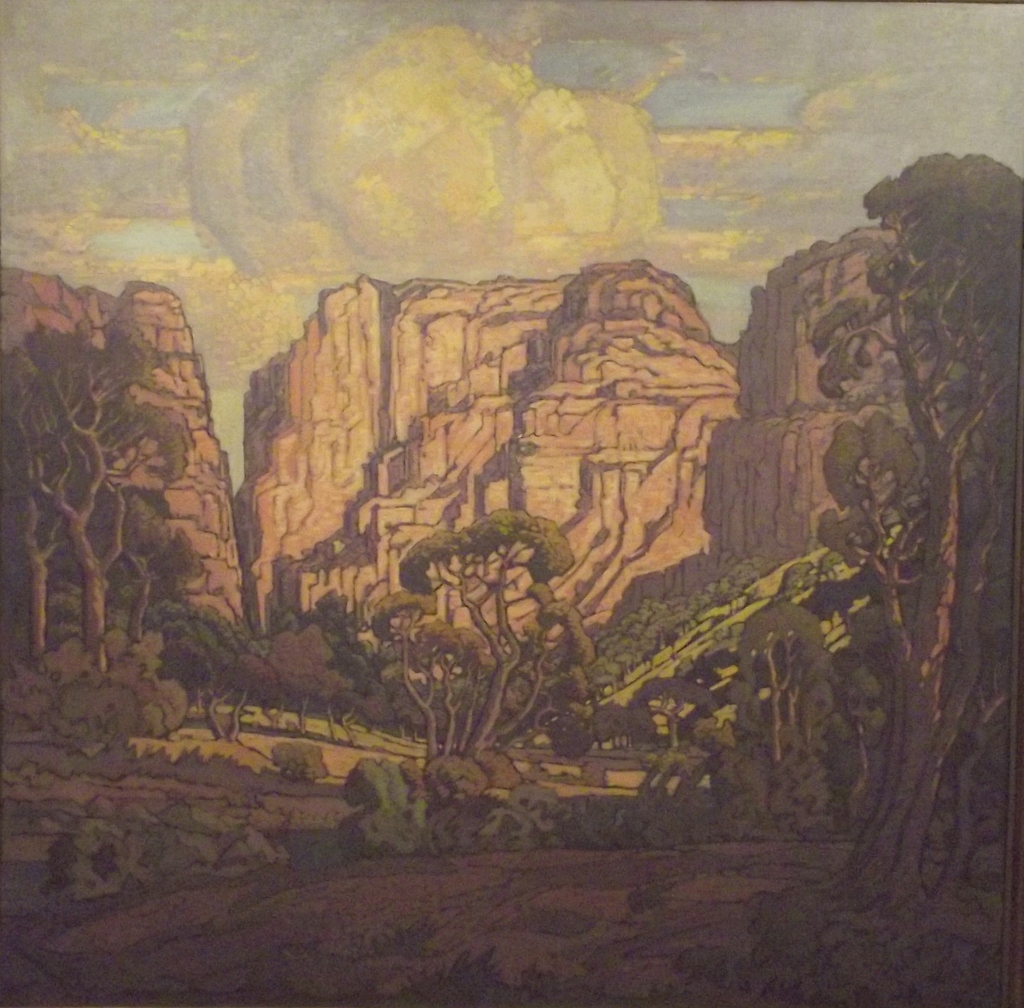
This rendering of the Kloof is very close to the Station Panel version (see “Rustig in Rustenburg” and “A backward glance.”) It is less simplified than the Panels. It may have been done in the studio from the same sketch. Pierneef did many versions of Rustenburg Kloof, and some are clearly plein air works. There’s the famous pic of young Pierneef in his grass- walled atelier; on the easel is a painting of Rustenburg Kloof and leaning against the rail a shotgun: more Hemingway than Monet. ( You couldn’t just nip up the road to MacDonalds back then). There were also daring (for their time) versions of the Kloof done in his experimental phase after his 1925 visit to Europe. This one is at the La Motte estate in Franschoek
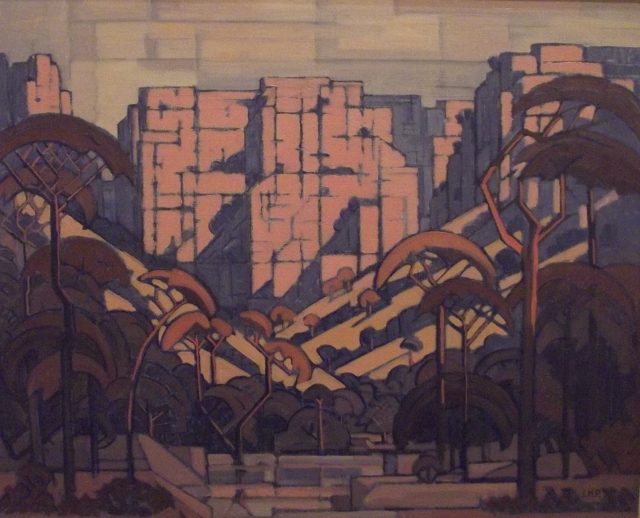
Last November Hermann Niebuhr and I paid the Kloof a visit; my fourth. Having worked our way through the traffic snarl ups and stocked with boerewors, we booked into one of the chalets there. The resort is well looked after. There was a constant hum of lawn mowers. Next door to us were two contract workers, their eyes glued to DSTV. The previously tatty chalets at the end have been recolonised by the Volk. We took a stroll up the Kloof, still waiting for the first summer rains. We found two dassies engaged in a bloody fight for supremacy. Oblivious to our presence, the two flailed about in the stagnant rockpools. A little metaphor for the gruesome scenes playing out at nearby Marikana.
In Pierneef’s Kloof, you can discern a stream in the left front, around where the darker toned foreground ends.That stream was there on my last visit, but someone has decided to make a water feature of it. Now the area around the central tree in Pierneef’s work is a dam. (Damn!) I can’t tell if it’s an improvement or just another case of bulldozing our history away. Next morning I was up at dawn and with the No 8 Sable brush in hand I finally saw the first light hitting that big rock face. I could hear the sounds of early morning traffic as booming Rustenburg creeps toward the Kloof. Wonder how long it’ll be before Mac Donalds does build a drive thru here?
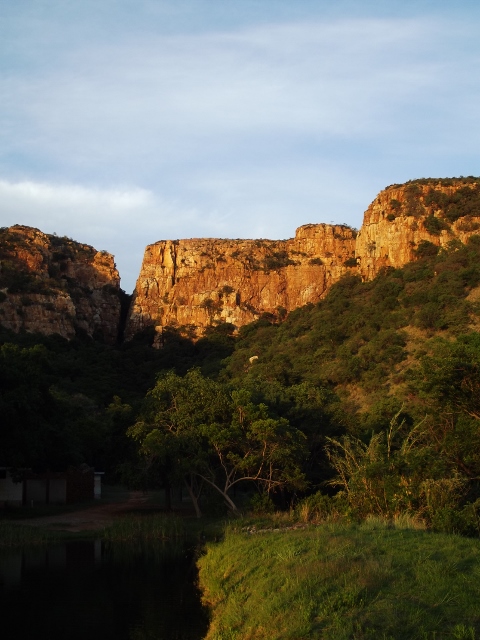
Rustenburg Kloof, November 2012
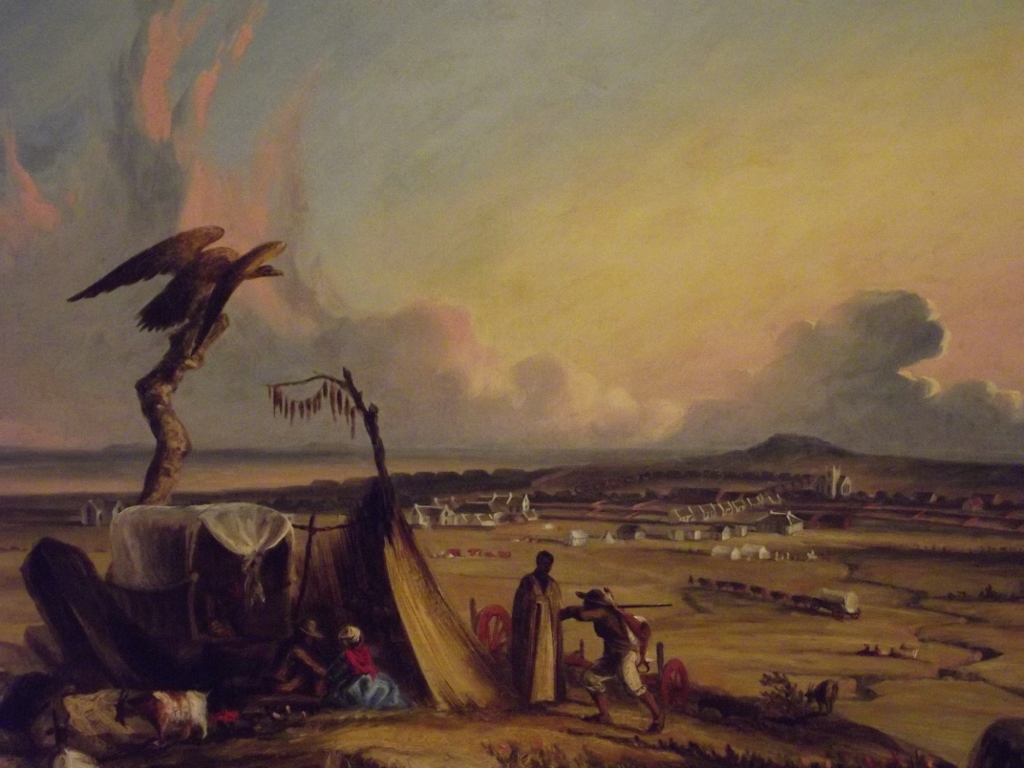
Bloemfontein by Thomas Baines. (Note the biltong above the tent)
Last November I stopped off in Bloem on my way up to Fordsburg. I met the curator of the Oliewenhuis Art Gallery, Ester le Roux, to discuss the upcoming show. For those of you who think there’s nothing more to Bloem than the Shell Ultra City, I suggest you head for the Oliewenhuis and cast your eye over their very good collection of South African paintings. You can have an alfresco lunch too whilst admiring the fine lines of the stately old building.
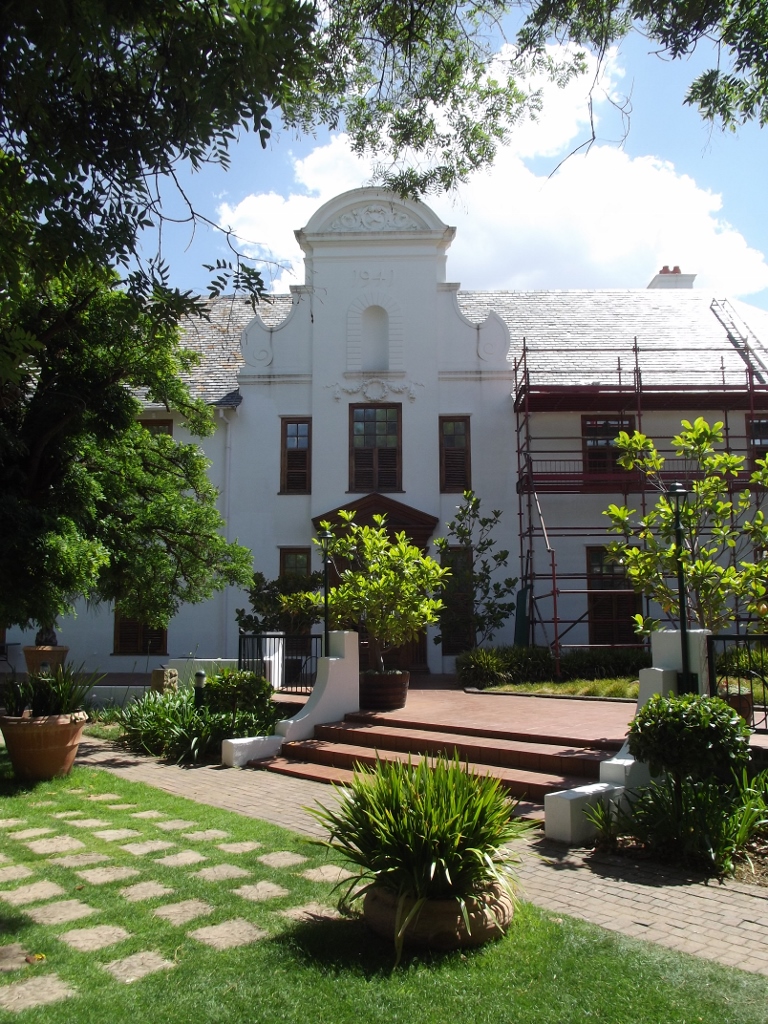
A truly impressive expanse of lawn rolls out to the surrounding koppies. And yes, there are many wild olive trees here: hence the name. William Mollison designed this Neo Cape Dutch beauty in 1941 and it later became the abode of the State Presidents of the Republic when in Bloem. In that Rubicon year of 1985, when I was propping up the bar at Jamesons in downtown Joburg, PW Botha handed it over to the National Museum to be used as an art gallery. That was the best thing the unlikeable old Krokodil ever did.
Monique Pelser and I open our show here on the 3rd of October. It’s an extended version of the show we did in Stellenbosch last year. Ah, the waxing and waning of the Pierneef project. I’ve been to 20 of the 28 sites so far and I guess it won’t be over until I’ve been to all of them. I’ve taken to revisiting sites: Rustenburg Kloof four times since 2007. Ditto Meiringspoort. There may be something pathological going on here, but I often don’t spend enough time at a site, or can’t find it. In 2011, I drove halfway around Lesotho looking for the Maluti mountain site, without success. “Malutis, Basutoland” is the Station Panel site nearest Bloemfontein. I’m going to have another crack at this riddle at the end of the month, just before the show. Malutis, anyone?
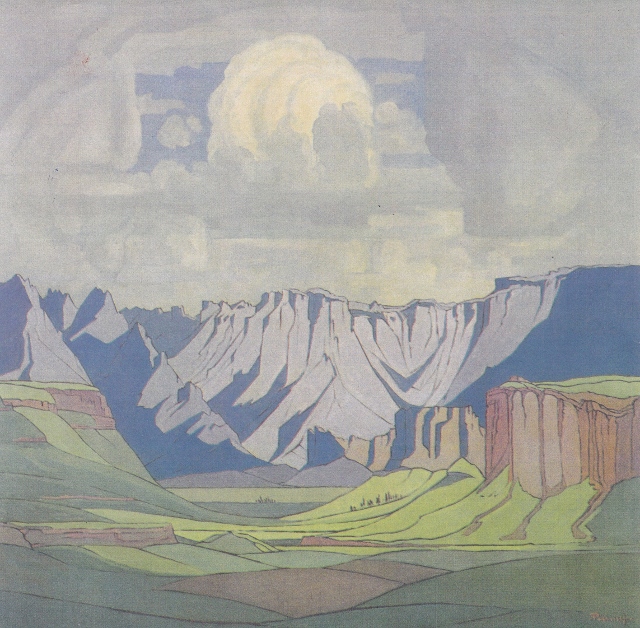
JH Pierneef, Malutis, Basutoland. c1932
I
Our tale takes place at end of a long summer. The aging artist is in Mpumalanga, near the hillside town of Waterval Boven, looking for the waterfall pictured below
Boven is your proverbial one horse town. It awaits gentrification. Shabby old buildings in need of a lick of paint rub shouders with new, hopeful ones like the Madonsela Library. We had coffee in a rustic establishment overlooking the grasslands on the edge of town. It is owned by Michael Tellinger, who believes he has found evidence of an ancient civilisation in the vicinity. New Age pilgrims to the African Stonehenge hold trance parties there. The nature reserve around the Waterfalls is a popular rockclimbing site, and so the town lives on as a getaway. But in Pierneef’s day, the centre of town was the extensive railway siding, built by Paul Kruger in his quest to build a line to Delagoa Bay, away from the meddling hands of the British.
Just down the road from the town, we could see the falls, but accessing them was a problem. The official entry to the nature reserve wasn’t exactly inviting

Is this where I get my ticket?
Puzzled, we headed back to the town where we spoke to a rockclimber who advised us on a roundabout route. Now we had the right approach to the beast, but there were still challenges
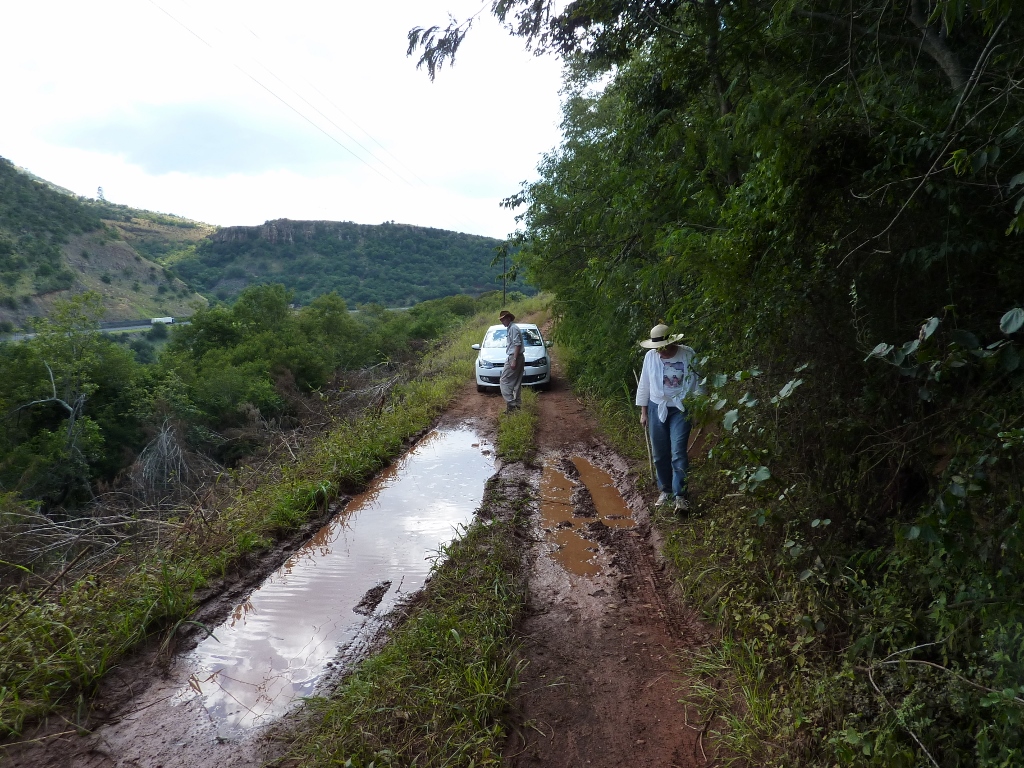
why didn’t I bring the Jeep?
We drove our little rented Polo as far as we could then headed into the thick grass, all the while keeping a wary eye out for wild beasts or two legged predators. We made our way through fragrant grasses in the balmy heat with only the sound of birdsong to bother us. Here men had toiled mightily to lay the tracks alongside us, many of them falling to fever. And then we saw the mighty Elands river plunging over the rocks.
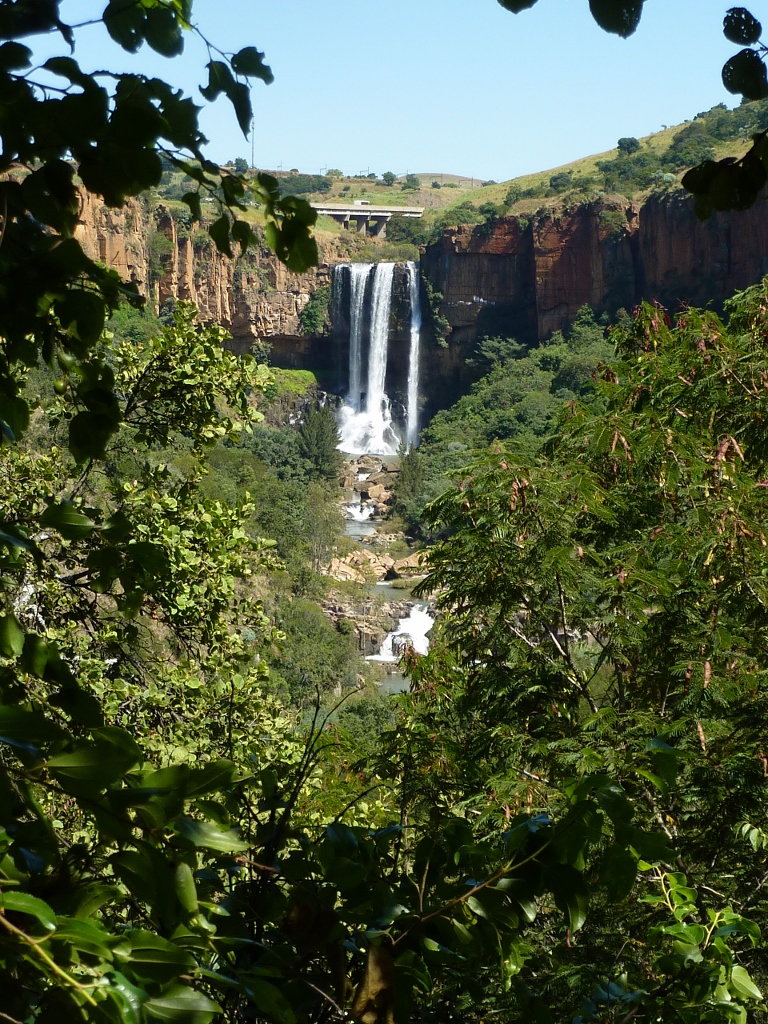
white waters ahoy!
We were tantalisingly close to ground zero, to the exact spot. We just needed to be a lot lower down. And here, at the end of summer. the way down was overgrown by a mass of dense shrubbery. Perhaps this explains why, of all the panels, this one, with its ochre grasses, depicts a winter scene. Had agile Pierneef, aged 43, and younger and more determined than your aging scribe, slithered down that slope knowing that the most dramatic composition was there to be had? Or had he got at it from the other side, easily crossing the low winter waters? We spent a couple of hours perched on the edge, drawing and chewing over these questions. We noticed too, that the waterfall has considerably widened since Pierneef painted it; in the 1940s a weir was built at the top of the falls to widen them. And then we turned back, elated at having found the place, and as so often happens, a little frustrated too. We were so very very close….
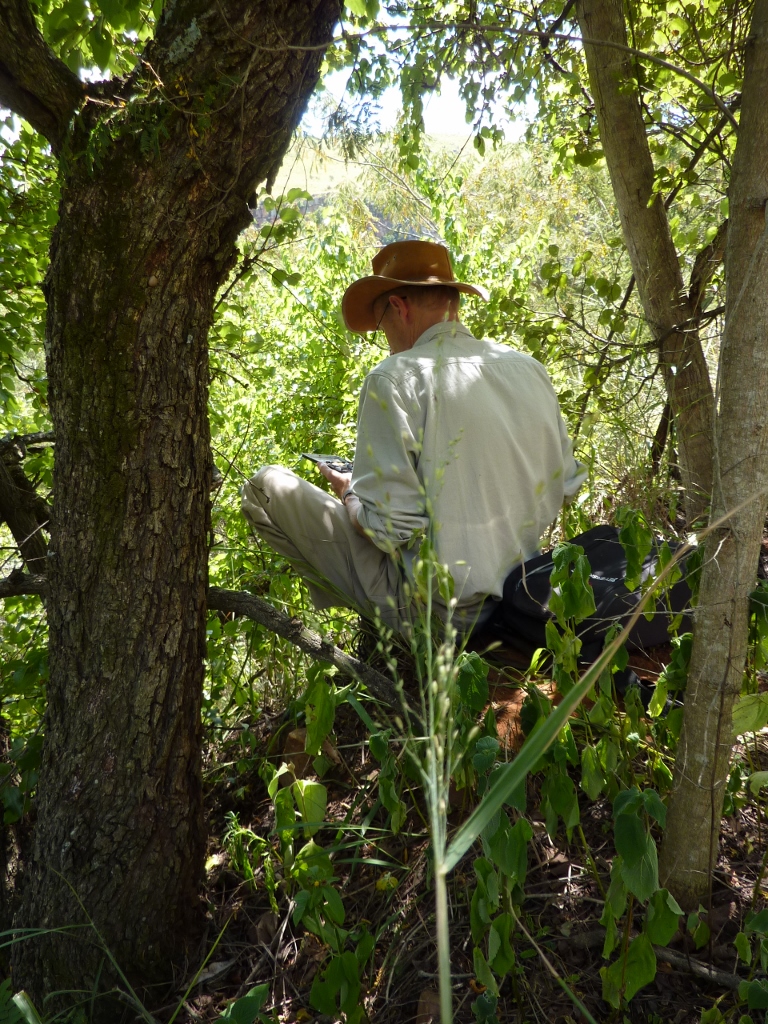
Watercolours from the edge
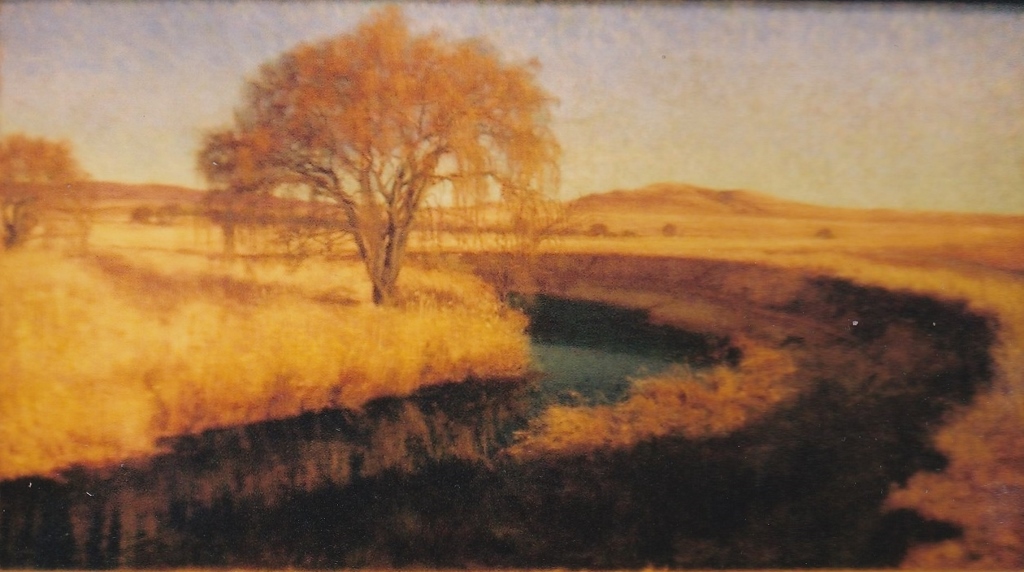
This is one of my favourite paintings. Its called “The peace of Winter” and it’s by Bertha Everard King. If you’ve ever been in the Mpumalanga highlands in winter before the grass burns, you’ll get it. Cold, crystalline nights and glorious warm still days. Bertha trained as a concert pianist, then studied at the Slade art school in London. She came out to SA in 1903, and taught for a while. In 1905 ,aged 32, she married a farmer. The farm was called Bonnefoi, and it was on the great escarpment where the northern Drakensberg drops down to the lowveld. In this corner of Africa, she found her life-long subject. Like many landscape painters, hers was a long identification with the land, a slow distillation of its essence. In the Oliewenhuis Museum in Bloemfontein, I came upon another gem of hers
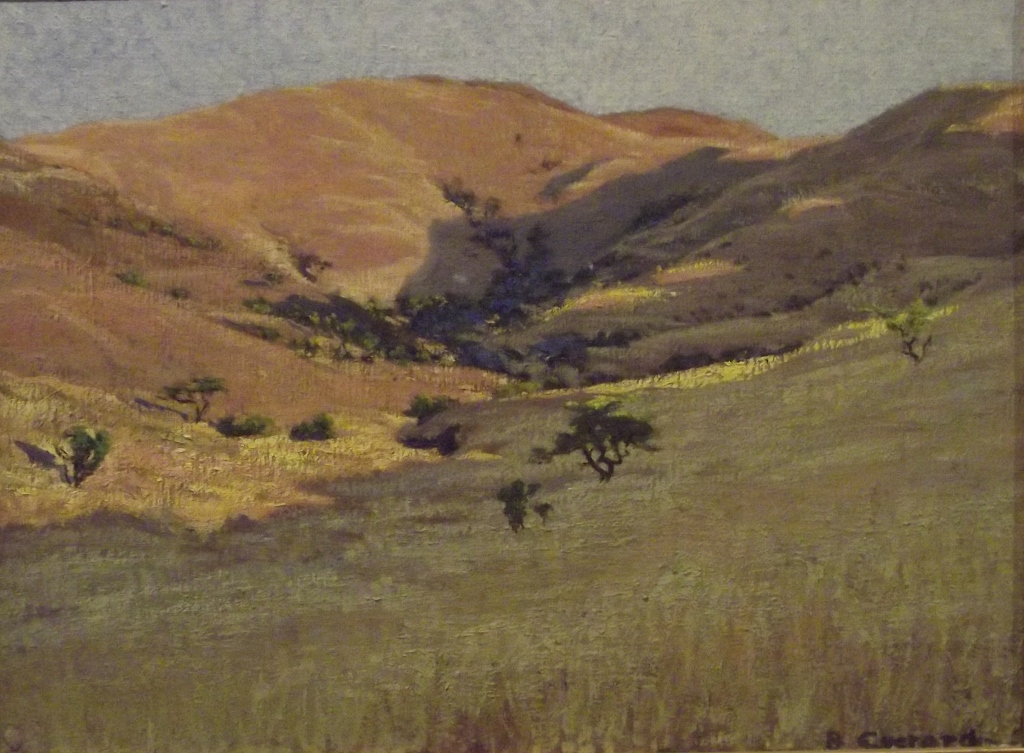
This one’s called Winter in the Lowveld. Her later work has hints of Post Impressionism about it – in 1921 she relocated to Paris for a five year painting sabbatical .You have to know what you’re doing to render those shadows on the hills – those are very tricky half tones. Then there’s the touch of chrome yellow for that last shaft of sunlight slipping through on the right. And the splodges of ultramarine in the darkest recesses of the mountain. (Double click on the image to get the close up, dear reader). She worked a lot outdoors, and had a hut built at one of her favourite haunts overlooking her beloved Komati river. Bertha died on the farm in 1965, aged 92.
Bertha’s sister Edith was a good watercolourist,and Bertha’s daughters Ruth and Rosamund are significant painters too. Collectively they’re known as the Everard Group, and the lineage continues today in the work of Natal – based Nichola Leigh. Bertha’s standing as one of the pioneers of SA painting is secure although perhaps slightly overlooked. Remarkably, the group never descends into self parody: each generation shows innovation and individuality. I am delighted to see that the descendants of Bertha have a website up and running with some evocative pictures of the farm in the early days. (www.everard-group.com)
Late summer in 1970. The Becker family is driving down south to Plettenberg Bay. The mountains are covered in pink heather as we catch our first glimpse of the sea. We peer over a bridge spanning a vast chasm. Far below us, raptors ride the thermals rising up from the Bloukrans river. In the Tsitsikamma forest we visit the Big Tree. Mysterious scents rise up from the forest floor. Somewhere close by, elephants pad about, us kids can feel it. Huge yellowoods tower over the canopy, trailing long billowing vines. Later, we get into the Fiat and drive down to Knysna. First stop, George Rex’s grave. The royal son (so the story went) who settled here in 1816. Then we wind our way up to The Heads. I run through the scented scrub, and suddenly I pull up short as the cliffs drop away into the vast ocean. And I haven’t been there since. So on a rainy day early this month I went back to this iconic South African tourist site to see what Pierneef saw.

There were patches of drizzle from Oudsthoorn and I had the lights on over the Outeniqua Pass. George to Knysna takes longer than you think: most of it is an 80 kph speed zone: most of it is a suburb. Navigating through a maze of expensive SUVs, I made my to the Heads. The road angles up through expensive real estate, those ever creeping global bunkers that announce our worldly success. A light rain came and went. The large chunks of rock and forest looked sombre and foreboding. No chance of a painting session yet, so I called my old friend Chris du Plessis, the former owner of the world famous Xai Xai bar. Glamorously, we met in the parking lot of Fruit and Veg City, where we obtained two Paninis. We went up the road to Thesen Island, and sat in Chris’s Jeep eating our lunch. In front of us a raincoated fisherman cast out into the placid lagoon. Assorted sea vessels bobbed nearby, remote from their purpose as pleasure craft.
Back at the Heads the light was better and I got out the painting kit. A timber viewpoint juts out where Pierneef would have made his sketches, but I set up a bit higher up the road. After a while I was joined by a bloke from Pretoria called Wessel Loubser, who turned out to be an amateur watercolourist. That made two of us, so we talked about hot pressed vs cold pressed papers, and how to properly stretch them (dont oversoak before you tape it down!) Wessel got called away by his wife, and I was left alone with the urgency of getting it all down and the usual struggles with ineptitude. Frankly, I can do without the puzzle of rendering light falling on an expanse of water. For that, we modern watercolourists are forever taunted by the genius of good old JMW Turner’s Venice masterstrokes.

For over a hundred years, ships were piloted through these monuments of stone, and departed laden with forest plunder. All those yellowood roof beams and that stinkwood furniture! Oh well. The light was fading, and I would be going back in the dark. But I had what I wanted for now. Its just a note, but one day I’ll be back to see it as first light reddens the rocks, the way Pierneef saw it.
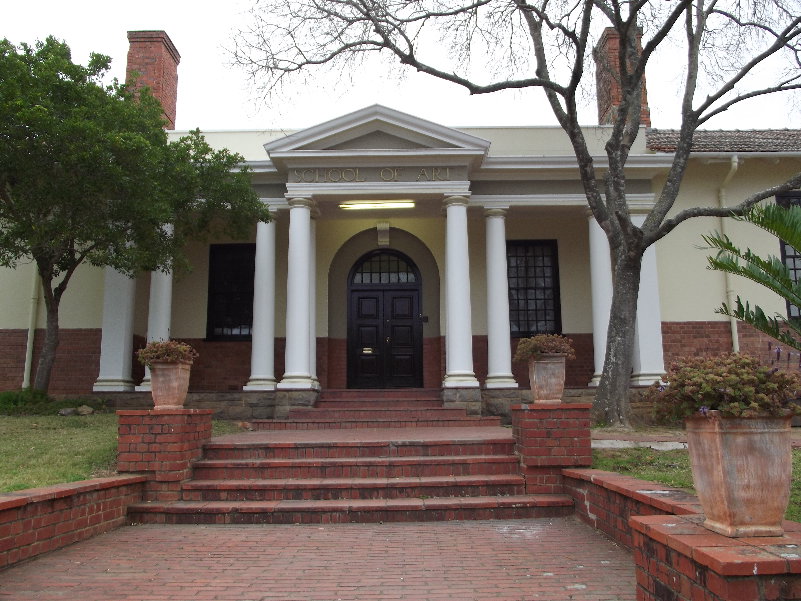
through the Doric columns to the land of Art
I took a drive up the R62 to De Rust with my old friend Anton Chapman.The klein karoo was bathed in a moody Autumn light. We had a box of framed watercolours on the back seat, destined for Diane McLean’s Portal gallery. We were putting up a group show called Spektrum, linked to the KKNK. Estelle Marais, Hermann Niebuhr and Sharle Mathews completed the line up. The work ranged from Diane’s highly finished still lives to Anton Chapman’s recent meandering watercolours. Our common link is that we all – over a period of several decades – passed through the hallowed neo classical doorway of the Rhodes Art School. That’s it there above us, in case anyone’s feeling nostalgic. Ah yes, the great enlightenment project in the heart of Xhosa country. But lets not go there now. It took a day to hang the show and it looked fresh, varied and coherent.

Artist as curator backed by Niebuhr abstracts
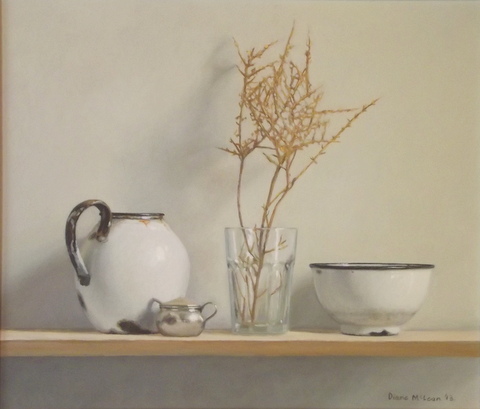
The McLean still life
With the show up and ready, we took a drive through to Oudtshoorn. You can see a lot of bad art at the KKNK, but in the Prince Vincent building there was good stuff, ably overseen by Sandra Hanekom. Clare Menck’s ” Vanitas” show, with still lives by some of our best painters, was a highlight. There were also good shows by Ian Grose, Pauline Gutter, and Cobus van Bosch. I really enjoyed Olaf Bisschoff”s witty and subversive “Streeksbiblioteek”: old books given new life and meaning through paint.
The 33ks back to De Rust is ostrich farming territory. A lot of ostriches died in the recent bird flu scares. There are a lot less of them now and the farms are restocking. The landscape looked desolate and dramatic, full of boom and bust stories. Only the hardy ones stick it out here.
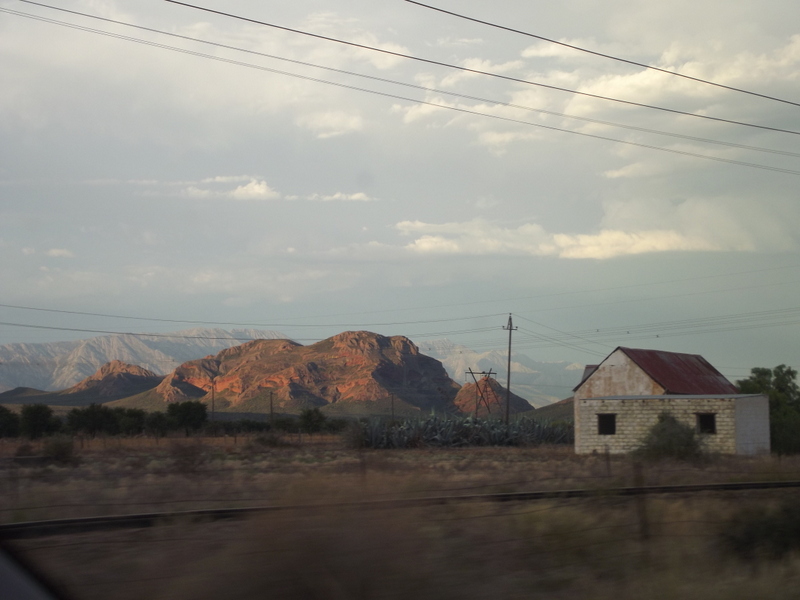
klein karoo farmhouse

Mr Smith and friends
Down here in the deep South I met an artist called Richard Smith. We found that we both owned Martin acoustic guitars, and we started playing together and called ourselves The Pencilmen , for obvious reasons. Back in the days, Smith had been a cartoonist of some standing, working for the Rand Daily Mail and the Sunday Times. Sometime in the 1980s though, the smell of linseed oil proved irresistable, and he picked up the brush. He walked out of the graphic world into a richly coloured canvas, where he made landscapes with densely applied impasto. At the Cite in Paris, Smith took stock and his work shifted, resulting in large charcoal drawings of heads, beautifully done.
In between exploring obscure Bob Dylan songs, Smith has been trying to reconnect with his lost, somewhat repressed inner cartoonist. The big portraits often depicted people in dreamlike states. A grid was supermiposed, and on this grid were placed small icons – bits of torn up paintings, coloured dots, airborne birds. This moved the head back from the picture plane, as if foregrounding fragments of the inner space of the subject. Given the size of these works, the effect was often imposing and even sombre. But Smith has a sense of humour that will not be denied. He started drawing on large grids, this time wihout the monumental heads. The new drawings are a rogues gallery of characters and situations from a lifetime of observation, rendered by a master of the craft.

Understanding Philip Guston. Oil on board.30x30cm
And out of the drawings there is a series of small oils. They have the inventiveness of a Philip Guston or Robert Hodgins, where the paint itself guides the painter into obscure (and wicked) realms of memory and association. Rediscovering his levity has led Smith into a seam that promises great riches. Go and see his show. It is at Artspace, 142 Jan Smuts Ave, Joburg. Until 7 June.
Forgive, dear Reader, my lack of attention. There’s been a distraction, you understand. Yes, soccer. Watching the games, I find myself reaching for the mute button on the remote a lot. Mainly when the commentary gets irritating. And also that monotonous vuvuzela racket. But it was not always thus.
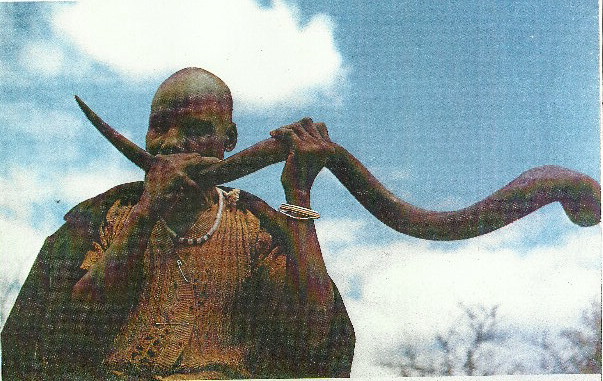
the traditional horn
The kudu horn has a more solemn intonation. And fewer decibels. The man who gave us the vuvuzela is a 37 year Capetonian called Neil van Schalkwyk, who has sold 800 000 of them, including an order for 40 000 from Sainsbury’s in London. He now also makes a slightly less noisy version, but will the cheap Chinese vuvus be so too? Sadly, Van Schalkwyk was unable to patent his invention. After all, the horn has been around for a while:
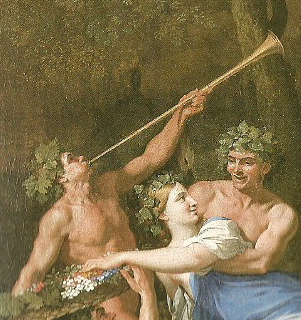
Nicolas Poussin 'The triumph of Pan' 1635
I actually like the vuvuzela. It stands for African spontaneity and ebullience. But Mondli Makhanya‘s point – that we’ve replaced songs like Shosholoza with a plastic cacophony- is true. Go to a game with 50 000 of those at full blast? No thanks, I’ll be watching at home. Sticking close to the mute button.
Coasting up the N2 near Riviersonderend
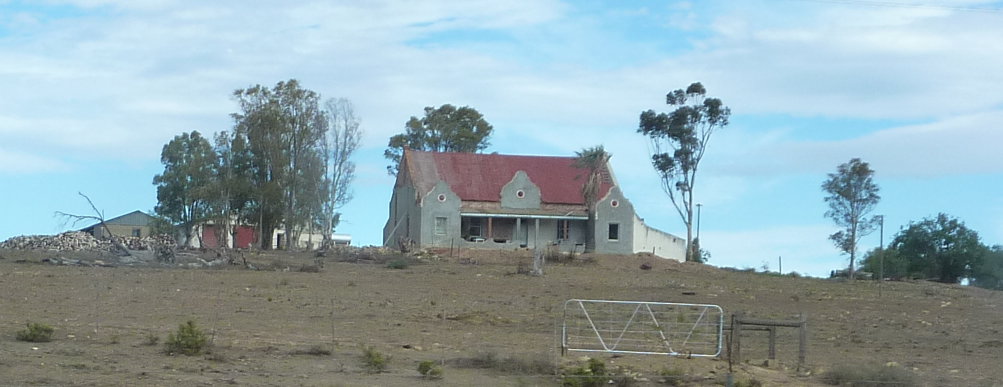
semi abandoned farmhouse
SA painter Walter Meyer put a lot of chickens in the pot painting this kind of thing. I can’t help thinking about stopping off to do a quick watercolour. But then I start thinking about the great American watercolourist Andrew Wyeth and his meticulous and chilling images of the deserted heartland (see Christina’s World 1948). Nah. Imagine having the ghost of Wyeth leering over your shoulder while you work. I’m having enough trouble dealing with Henk Pierneef, and he was a genial kind of a guy.
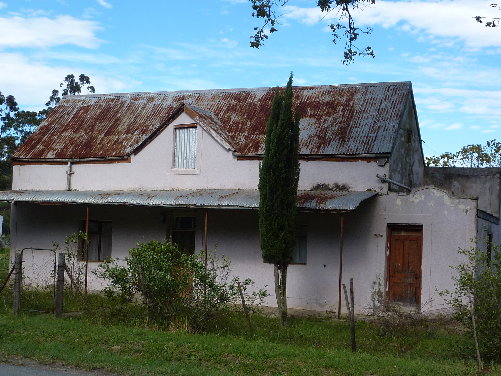
huisie in Suurbraak
Forgive dear reader your blogger’s absence. I took off to Stellenbosch to see if maybe I could find Harry Kalmer there and bliksem him after those nasty things he said about my paintings but no such luck all I saw was a whole lot of Dylan Lewis sculptures which didn’t really help so I went up the road to Jonkershoek and did a watercolour of Pierneef’s mountain in the late Autumn sun (and I would show it to you if my computer was working properly…)

 Travels with Pierneef