You are currently browsing the category archive for the ‘JHP history’ category.

Home, oil on linen 23 x 30 cm
1. It is 1998. The painter is on a dusty Karoo road. He is driving an old kombi, the map book lying open on the floor behind him. There is a boy with a dog on the road. The painter gives them a lift to a farm many kilometres away. Later, at home in Jo’burg, the map book falls open. On a page, there is a paw print left in dried blood. The painter remembers the dog.
2. The painter is on the road between Whittlesea and Aberdeen. The trivia of everyday life starts to dissipate and he feels his soul expanding into those large spaces. It is 10.30 am, the time he usually takes his dog for a small walk around the corner. He pictures the dog at home, curled up and alone.
3. The painter has a dog at last. He is visited by a friend, a prolific artist and painter of many dog portraits, including Paris Hilton’s dog, no less. He comments on the fine form of the beast and takes a photograph. He says she would make a fine subject for a painting. In order to avoid the ignominy of having his dog painted by another artist, the painter makes a work of her.
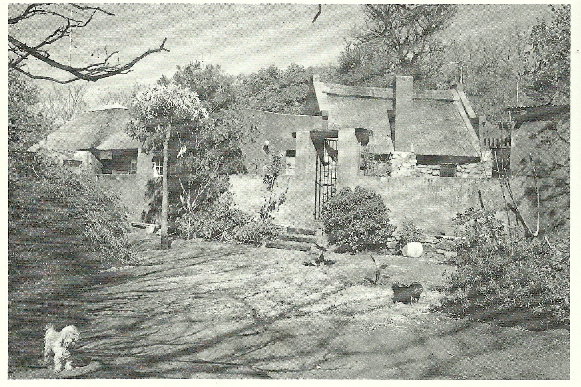
4. Pierneef’s home in Pretoria. Called Elangeni (place of the sun), it was built in the late 30s using stone and thatch from the area. Sad to say, the pic was taken after Pierneef’s death and so we don’t know who that mutt on the left belonged to. But I have no doubt he would have approved of the Africanis on the basis of its indigenous aesthetic appeal.
Us artists are a cannibalistic lot. The myth of the lone creator rules, but the truth is we are constantly nibbling away at each other’s work, taking up bits and pieces that suit our needs. We even have a word for this polite thieving between artists – it’s called “referencing.” Referencing is complimentary: I like your idea, your brushstroke, your colouration so much that I am unable to stop myself trying to emulate it. Our peers may be hard to resist, but there is also the weight of tradition. Hundreds of years of brilliant painters to look at, all better than you. No wonder young Marcel Duchamp drew a moustache and goatee on the Mona Lisa.
In our little South African artworld, the equivalent gesture of punk outrage must surely be Wayne Barker‘s Pierneef paintings. Back in the late 1980s, Barker, fueled by alcohol and seething with righteous anger at the apartheid system, set about defiling Pierneef. He took the hallowed landscapes and inserted into them all manner of subversive imagery. Fuck you, Apartheid overlords with your nostalgic ideas of the land! Fuck you, artists who cosy up to the Nats!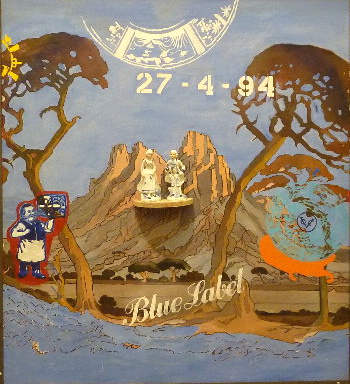
Barker’s work attacked the comfortable notion that landscape painting exists outside of politics and history. (The good theorists of the left, who had long deplored the absence of any reference to the Relations of Production in Pierneef’s work, were happy.)
Like so many before and since, here was a young artist taking aim at the establishment. But the thing about the artworld is its ability to incorporate the new pretender as well as the old Master. One may have thought 27.04.94 signaled the start of a clean out of the old white icons, an ushering in of the new. And yet, after a brief pause, the market in Pierneefs continued to rise. He is bought, studied, preserved and debated. And quite a few of us painters can’t stay away.
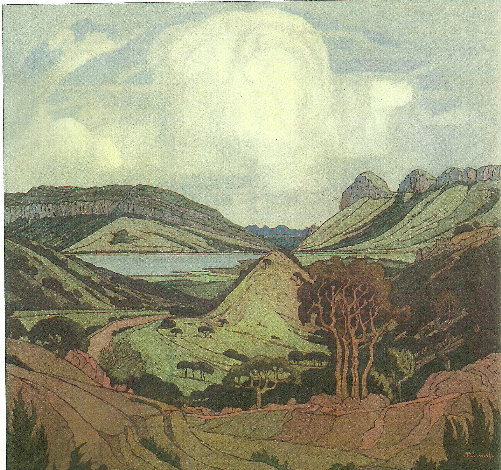 The Hartbeespoort Dam Station Panel.
I found this site easily enough. It’s on the R514 as you head towards the dam. The day I was there (for I am not there now, dear reader) was the end of a long weekend and the whole of fun seeking Gauteng was roaring back to Egoli with boats, bikes, caravans and jetskis in tow. Nevertheless, I put on the suntan lotion and got down to work. The noise coming up from the road started pissing me off after a while, but in the stolen quiet moments I realised The Thing, and that is that what Henk had before him was Nirvana, no less, and that we, in our headlong rush toward comfort, acquisition and consumption, are screwing it up. Behind the rash of Tuscan townhouses that ring the Dam, the water glows an eerie green. Cyanobacteria – a malevolent and toxic algae – flourishes in this sewage laden water. You wouldn’t really want to go waterskiing there.
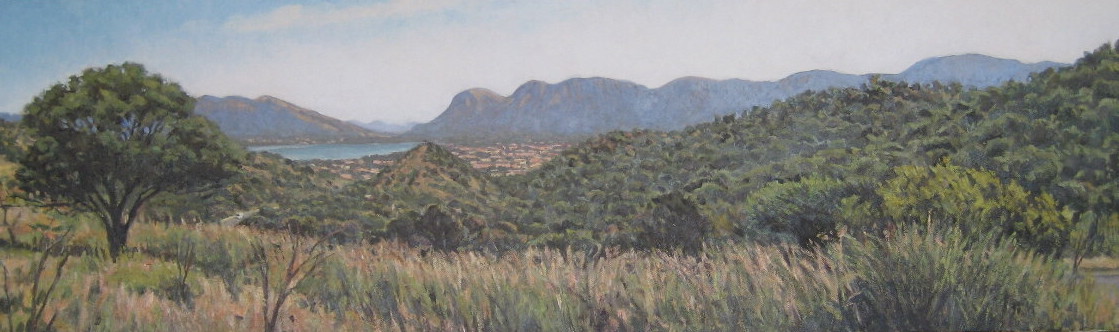
"Hartbeespoortdam" oil on canvas. 30 x 100cm
It was in a nearby hotel that Pierneef was to meet his second wife. It’s been noted that around that time, too, his work and career began to flourish. The stabilising influence of a good woman on the daydreaming artist, no doubt.

The redoubtable Mrs P
I met a woman last year who had rented one of the rondavels at the Pierneef’s Pretoria home in the 1940s. The young couple admired Pierneef’s work, and, at one of his home exhibitions, scraped together the money to buy one of his watercolours. But, announcing that “Henk’s paintings must only hang in the finest homes in Pretoria,” Mrs P cancelled the sale. Eina.
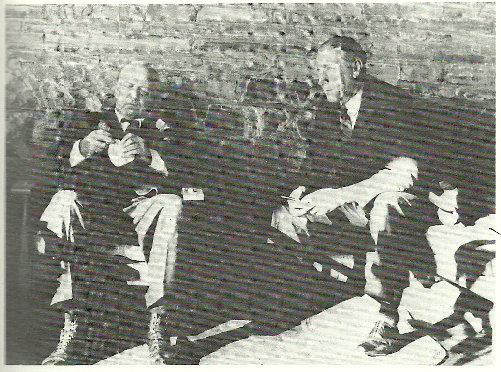
Pierneef parking out on the stoep with Gustav Preller, sometime in the 30’s. I stopped off at Preller house on the way to find the Hartbeespoort Dam site. Preller, a pioneer of Afrikaans, edited Ons Vaderland and wrote a book on Piet Retief and other volumes on the Voortrekkers. His house is on a sunlit koppie with views of the Magaliesberg to the North. The use of nearby stone, slate and thatch makes a dwelling that perfectly fits its surroundings.
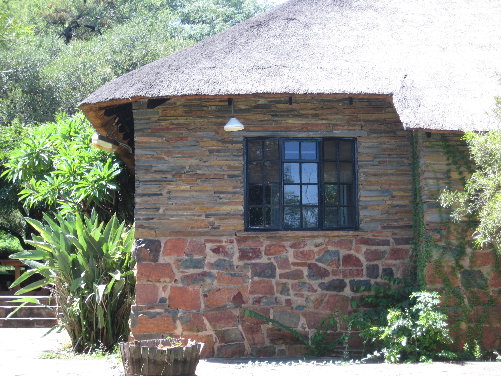
preller se plek
The place is a bit run down and there’s no-one else around. Around the back there’s a courtyard and some rondavels.
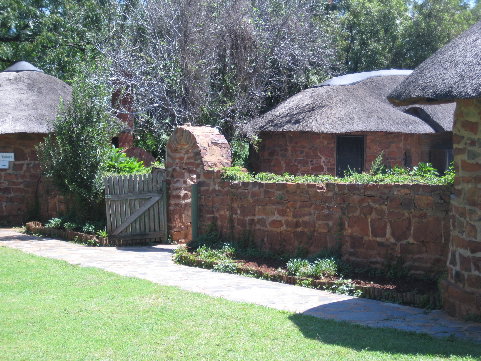
It was in one of these that the poet and naturalist Eugene Marais, worn down by decades of morphine addiction, spent his last days. The scale, shape and colour of the dwellings is deep South African, the work of people in touch with their landscape. There’s a modesty of scale here that reflects early Afrikaner Nationalism, if you like. And just over the hill is the nuclear research facility of Pelindaba – the love child of a rampant lust for power.

The young Pierneef. A romantic and a dreamer, by the look of things. An earnest young artist who admired – even copied – the rock paintings of the Bushmen. Who felt the art of the Ndebele and the San would be a good starting point for the evolution of an authentic South African art. At the same time, he took in modern European art movements. Back from Paris and Holland in 1925, he knew he could be a vanguard South African painter. But his 1927 show in Jo’burg, full of startling geometric abstractions, didn’t sell a thing. Earning a living from his brush, and with no other means of support, he retreated. His next show in Pretoria, of more moderate work, was a sell out. In 1929 the Johannesburg Station commission was given to him. That was followed by a commission to do murals in South Africa House in London. He was now the Establishment man. His shows were consistently successful. No bohemian or avante garde outrage here. The public liked what they saw and voted with their chequebooks. “Jy moet saamry op die wa met jou volk,” said Pierneef. In a sense, he also taught people to see the landscape. And laid down a template for the following generation of painters. He identified with a group of people who became very powerful in his lifetime. Does that make his art – his vision – a Nationalist vision?
sources: Nel, Pierneef, Sy lewe en sy werk.
So in 1870, John Ruskin was installed as Oxford University’s first Fine Arts Professor. Thus was born the modern art institution, where the production of theory is at least as important as knowing the craft of artmaking. And Ruskin wasn’t short of ideas. Or ambition. His inaugural lecture was a call to arms:
“We are undegenerate in race. We have the firmness to govern and the grace to obey. Will you youths of England make your country … a mistress of learning and the Arts? This is what England must do or perish: she must found colonies as fast and far as she is able … seizing every fruitful piece of waste ground she can set her foot on, and there teaching these her colonists that … their first aim is to advance the power of England by land and sea.”
In the audience that day was the young Cecil Rhodes, and we all know how keenly he took up the project:

hier kom Cecil!
Ruskin also thought it important for the youngsters of the chosen race to do a bit of physical work, so he set his students to digging roads. Cecil, who was frail, did not partake, but toiling along with the rest was an icy young man called Alfred Milner. Later on, he got rid of Paul Kruger’s rustic Republic and dragged the Transvaal into the modern age.
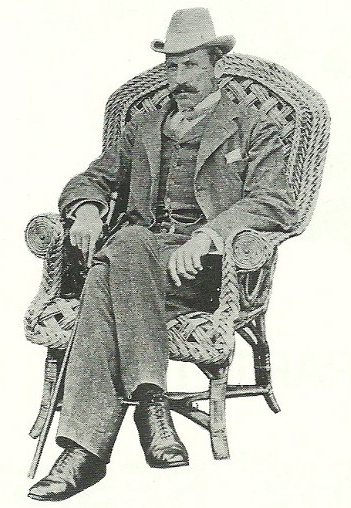
With cane in hand. Mr Milner
So what has this to do with Pierneef, I hear you ask? Well, the Boer War was a cataclysm for the Afrikaner people. Aside from creating a bitter sense of loss, it unified the Volk and gave them heroes. Those are crucial ingredients for the birth of Nationalism. And Afrikaner Nationalism is a subject that often crops up when Oom Henk is mentioned.
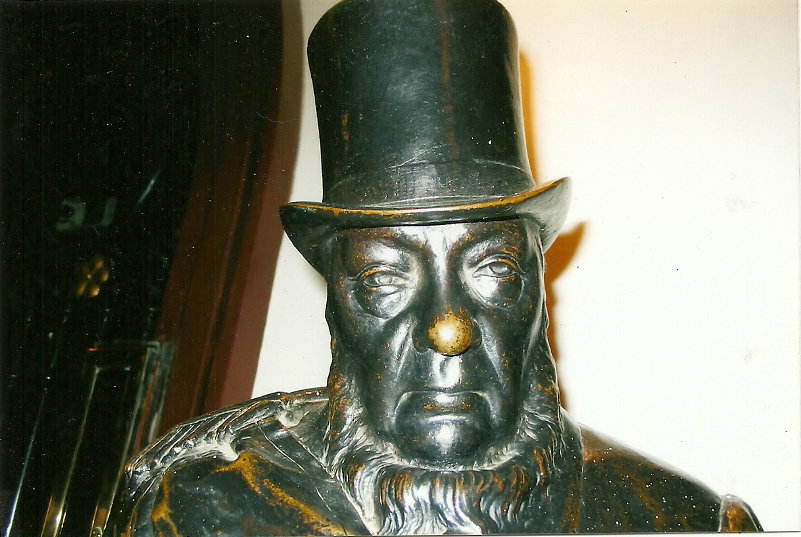
O Hel!
As you head up Graaf Reinet’s main road, there’s an impressive church but the one we want is just before you get to it, in a lane on the right. In there are the reasons for my journey. Completed in 1931, they hung in the concourse of the brand new Jo’burg station. They were meant to encourage the railway commuter to buy the long distance ticket and see the scenic virtues of South Africa. They got dirty and after some restoration by the artist went to the Jo’burg Art Gallery. And then in 2002 they were installed in the Pierneef Museum in Graaf Reinet, under the care of the Rupert Art Foundation.

die Pierneef kerk
There are 28 landscapes and four small vertical panels of indigenous trees. I’ve spent a bit of time in here and every time I see the work again I marvel at the achievement. This isn’t the Sistine Chapel, but it is a remarkable body of work for two reasons: It was completed in a three year timespan, travels included, and without the aid of colour photography as a reference. [Us modern painters are hopelessly dependant on our digital cameras. Oom Henk worked up his paintings from dozens of sketches and watercolours.] Secondly, the aesthetic of Pierneef was developed in virtual isolation. Most major modern artists and styles emerged out of some sort of collective effort. Pierneef ‘s response to the landscape didn’t build on an existing local tradition. It seems to have come out of nowhere.

the inner sanctum
Pierneef started work on the Station Panels in 1929. The General Manager of the SA Railways and Harbours was Sir William Hoy. For years he spent his annual vacation at the Marine Hotel in Hermanus, where he took the good air and fished.
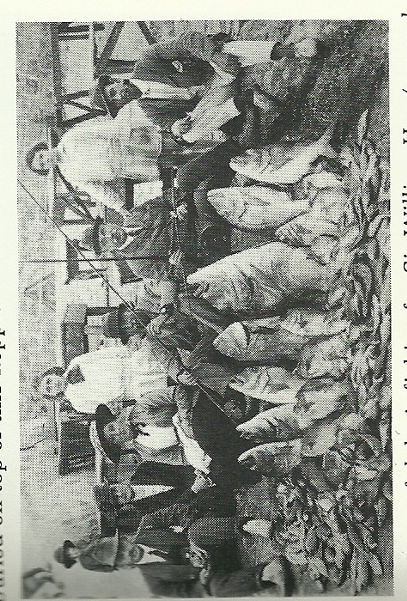
Fishing with Sir and Lady Hoy
The Old Harbour was under the jurisdiction of the SAR&H, and this could explain why Pierneef chose to include it as one of the Panels. Sir William may have enjoyed the artistic rendering of his retirement town. (Did JHP stay with him when he was in Hermanus? Did they share a bottle of port?) But he may not have relished the prospect of more tourists: He vetoed a railway line from Caledon to Hermanus. The station had already been built in 1912.
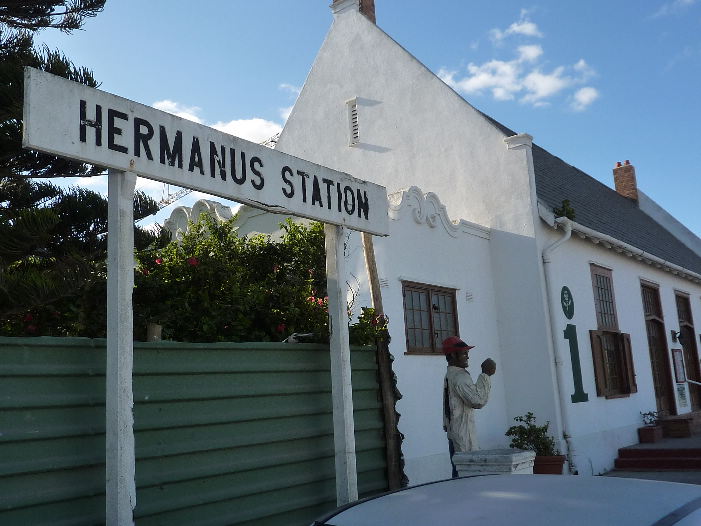
The station that never saw a train

 Travels with Pierneef